
“It’s Bumpy”
Our exploration unfolded through movement, sensory experiences, and the children’s growing curiosity about how materials behave.
At the table, an invitation awaited. Trays of red and yellow paint were arranged alongside pumpkin- and mushroom-shaped sponges. Before introducing the paint, the children began examining the sponges themselves. Their fingers traveled across the surfaces, noticing an interesting difference: one side was rough, while the other was smooth. Jules invited the children to use the rough side of the sponge to apply the paint. The children began dabbing their sponges, first into the yellow paint and then into the red.
As the colors began to overlap on the paper, something unexpected happened.
“It’s making orange!” Bryce exclaimed.
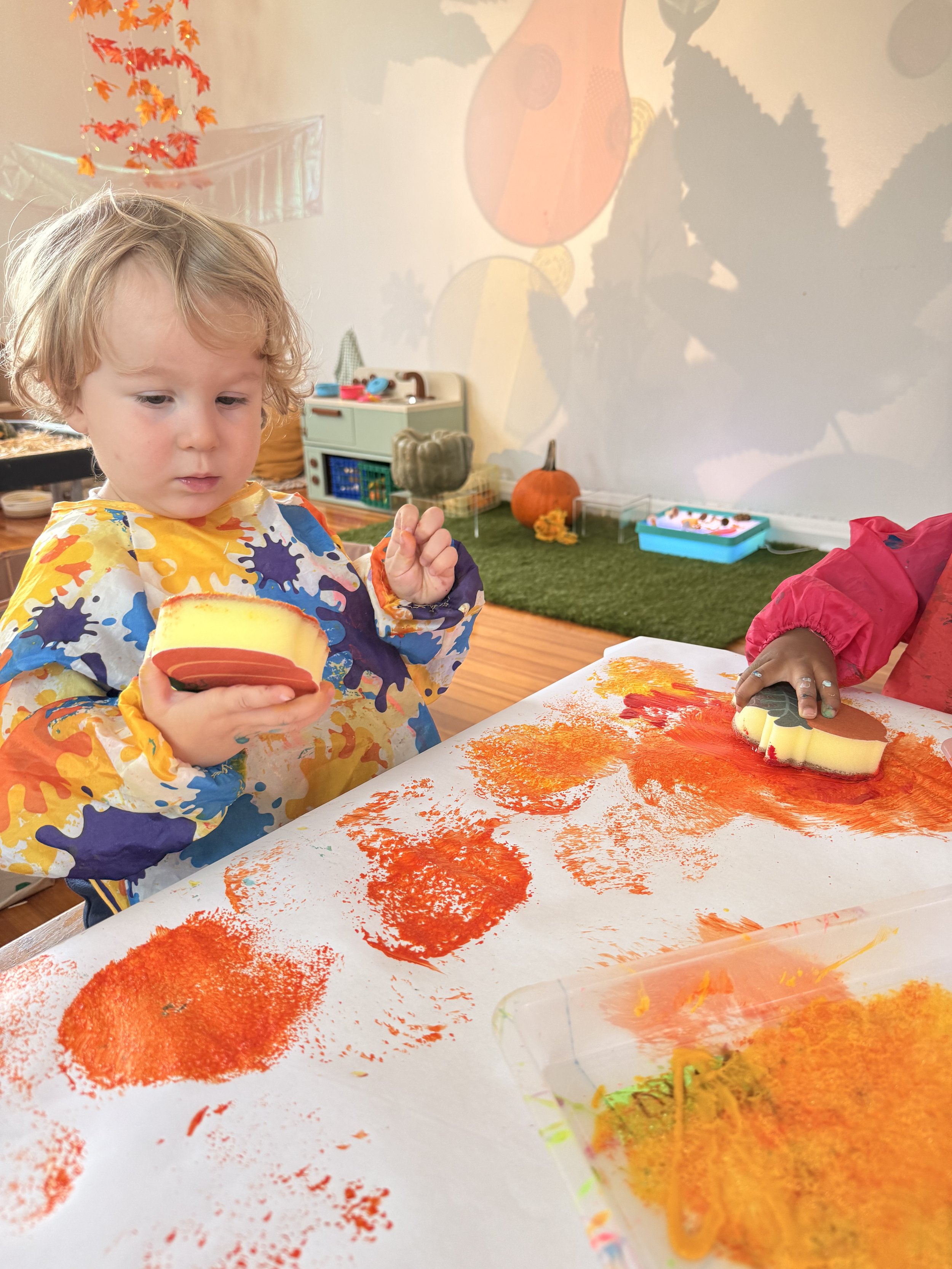
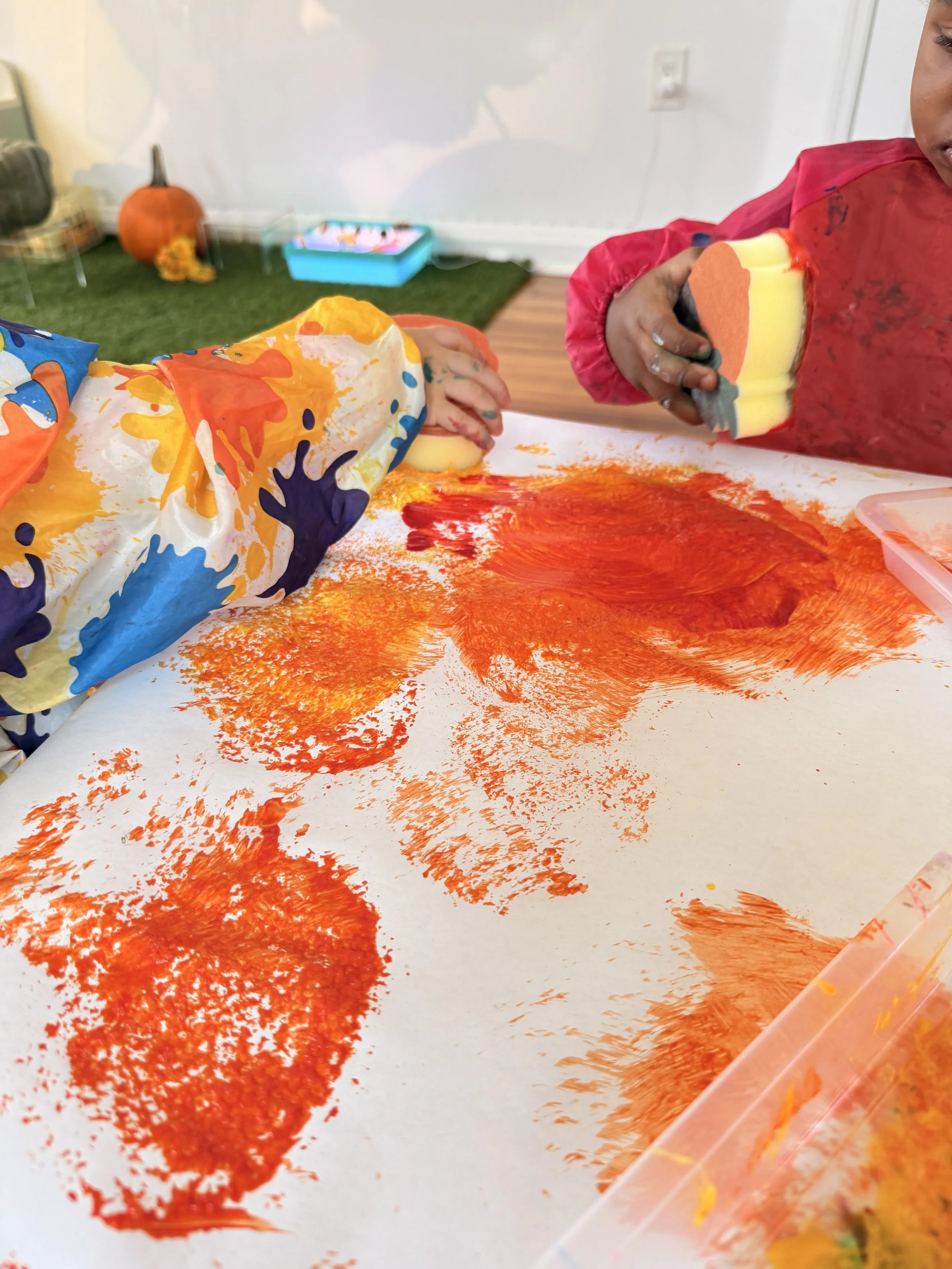
The discovery was immediate and exciting. Two familiar colors were creating a new one. Aden, meanwhile, became fascinated by something else entirely. As he repeatedly pressed his sponge against the paper, tiny bubbles began appearing in the paint. He giggled at the sight, continuing to dab and observe the bubbles forming beneath his sponge. While Bryce’s attention was drawn to the transformation of color, Aden seemed particularly interested in the physical response of the paint to his movements. With each press of the sponge, more red and yellow paint mixed together. Gradually, the white paper disappeared beneath a growing field of orange.
The children were not simply painting pumpkins. They were experimenting with cause and effect, discovering that their actions could change the appearance and texture of the materials before them. The process was filled with repetition, observation, and unexpected discoveries.
Later, the children’s attention shifted toward the pretend pumpkins scattered throughout the atelier. As they began moving the pumpkins across the floor, they noticed something interesting: the pumpkins could roll!
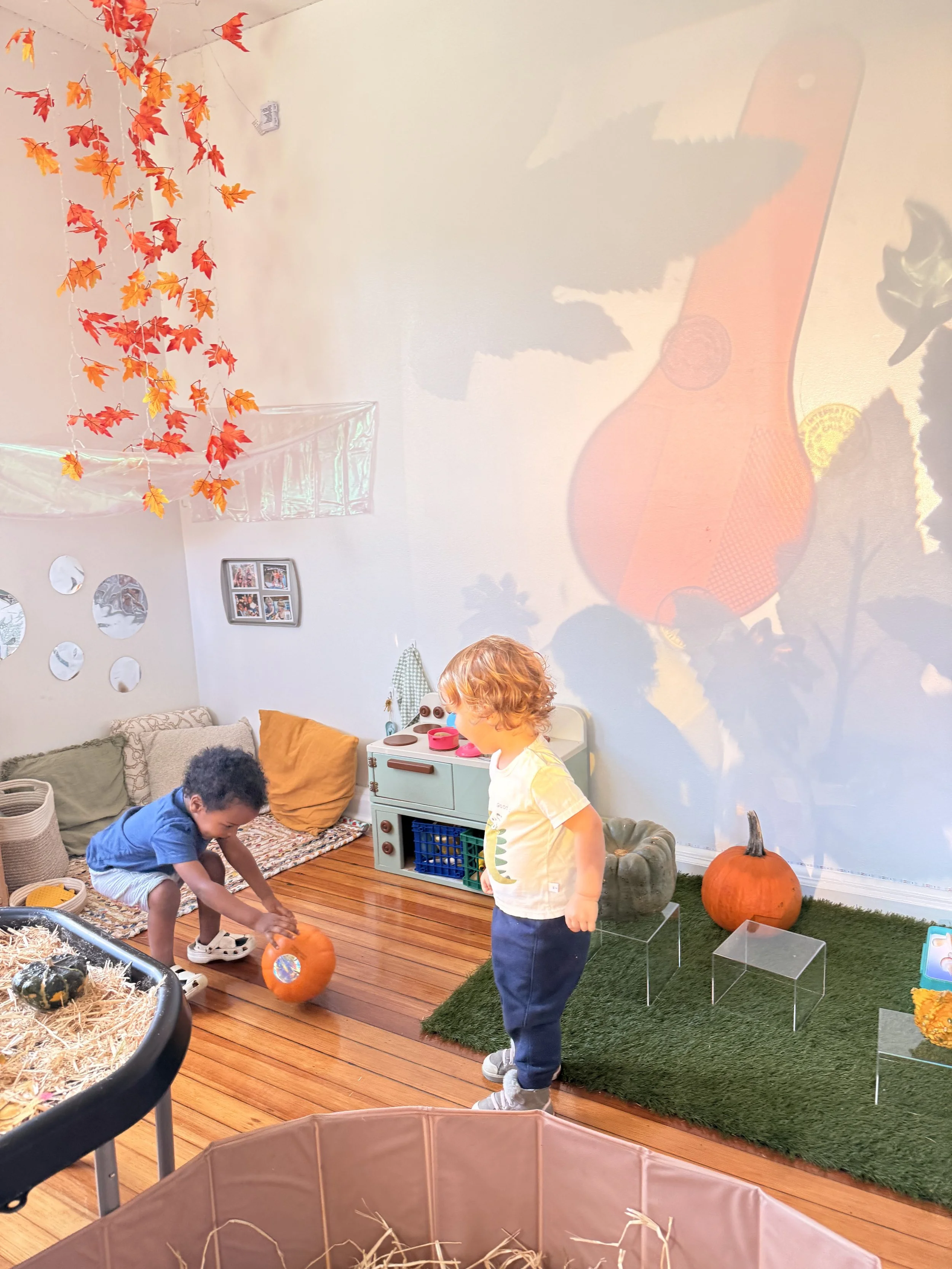
They took turns positioning the pumpkins on their sides and sending them across the floor, watching how their rounded forms allowed them to move. The discovery prompted further investigation. Bryce began to wonder whether the pumpkins could be stacked on top of one another. He carefully gathered them and experimented with placing one pumpkin above another, adjusting their positions as he explored how they might balance. This new investigation introduced a different challenge. Rolling required movement, while stacking required stillness and balance. The children were discovering that the same objects could behave differently depending on how they were positioned and manipulated.
As the exploration continued, the children’s toy vehicles became part of their investigation. Trains and buses traveled across the floor, moving through the atelier before eventually finding their way onto a large green pumpkin. Bryce guided his vehicle over the pumpkin’s uneven surface and made an observation:
“A bumpy road!”
The ridges and curves of the pumpkin had transformed it into an unexpected roadway. Intrigued by Bryce’s discovery, Aden brought his bus over to investigate. He moved it across the pumpkin’s surface, feeling the interruptions created by its natural shape. Then, looking back toward Bryce, he announced:
“It’s bumpy!”
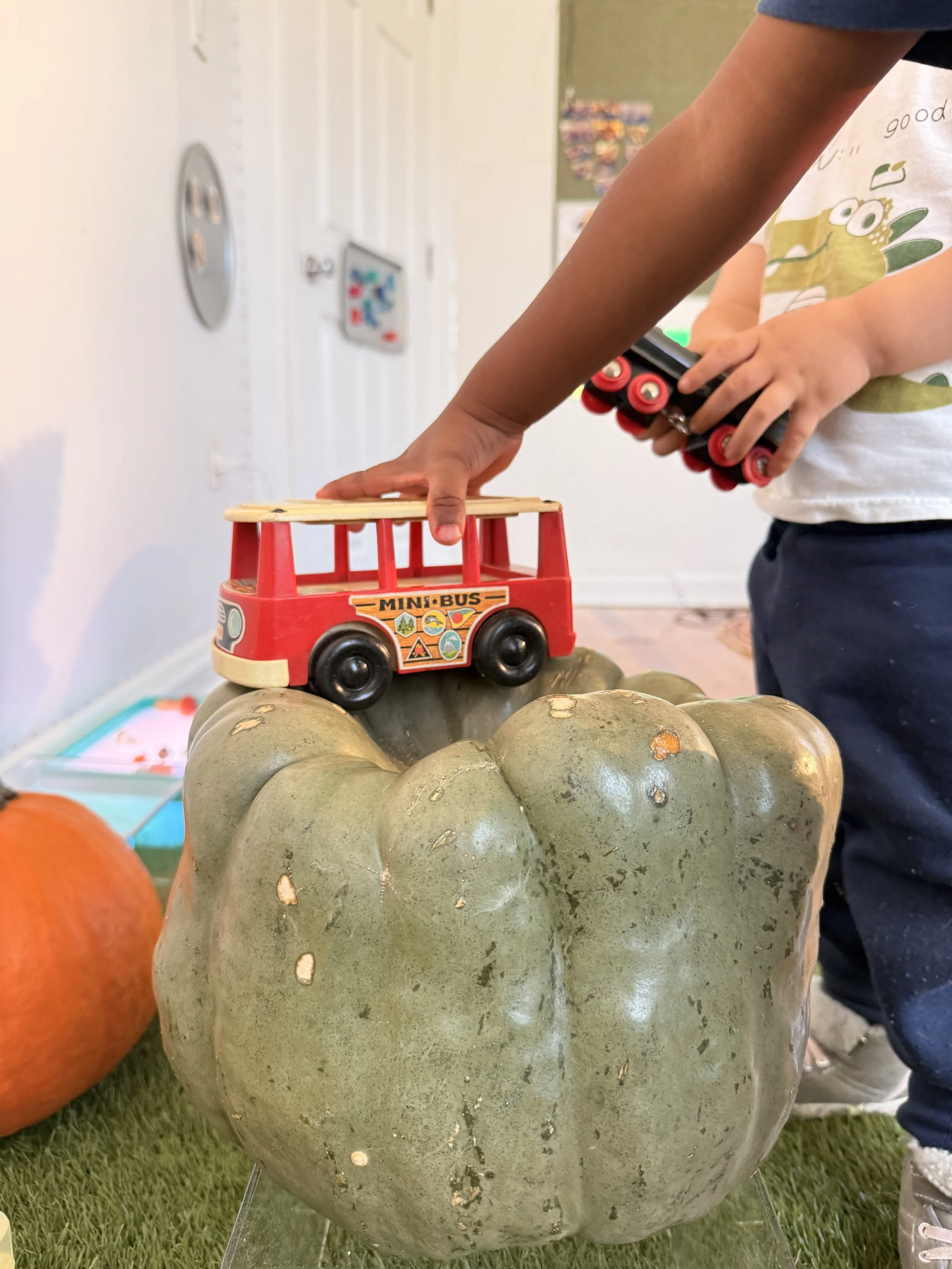
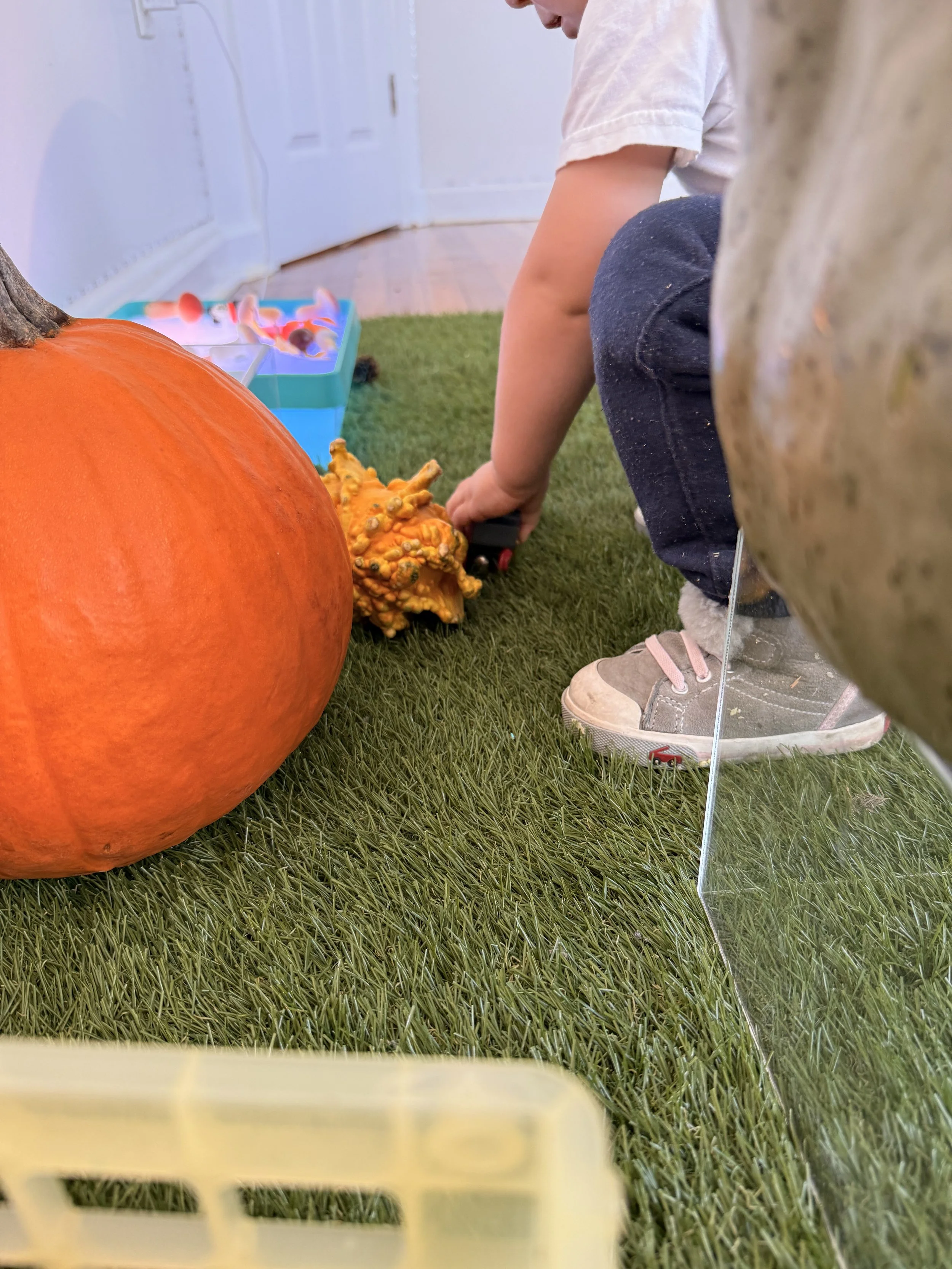
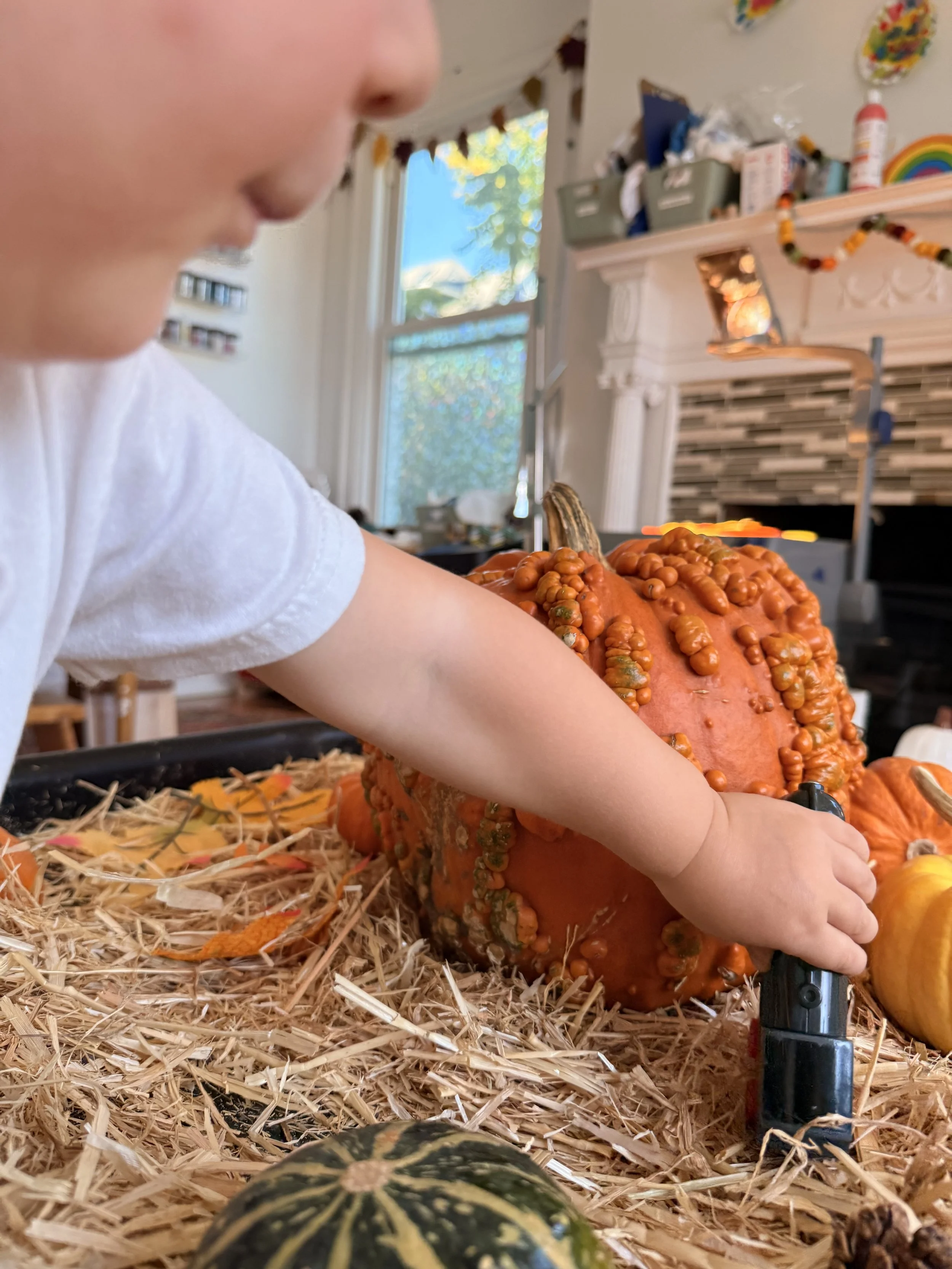
The children continued testing their vehicles on the other pumpkins throughout the room. Each pumpkin offered a slightly different experience. Some surfaces were smoother, while others had deeper ridges and more pronounced curves. Through their imaginative play, the children were revisiting an earlier concept: texture. Only now, rather than exploring texture with their hands, they were discovering it through the movement of their vehicles. A pumpkin had become a road, and the children were investigating how its physical characteristics influenced their play.
What stood out during this exploration was the children’s ability to revisit familiar materials and discover something entirely new. The pumpkins, previously explored through color, weight, and texture, became objects for rolling, stacking, and imaginative play. And the red and yellow paint offered more than an opportunity to create an autumn-inspired picture. It became a space for experimentation, where Bryce noticed the emergence of orange and Aden discovered the tiny bubbles produced by his repeated movements. Each child approached the materials with a different question, expressed through words, gestures, or actions.
What I found especially meaningful was the way the children’s ideas traveled from one experience to another. Their earlier observations of the pumpkins’ textures appeared again when they began moving their vehicles across the uneven surfaces.
This reminded me that children do not necessarily separate art, science, movement, and play into different subjects. Their learning moves fluidly between them.
A simple invitation can lead to unexpected discoveries when children are given time to investigate, repeat, and build upon their ideas. As educators, our role is not always to introduce something entirely new, but to recognize what has already captured the children’s interest and offer opportunities to explore it more deeply. Sometimes, changing the size of a container, introducing a different tool, or allowing familiar objects to be used in unexpected ways is enough to open an entirely new direction of learning.