
“I Found A Big Yellow One”
There is something beautiful about the way children encounter ordinary objects with extraordinary curiosity. A pumpkin, to an adult, may simply be a sign of autumn. But to a child, it can become an invitation to investigate color, weight, texture, shape, and possibility.
Our exploration began with an intentionally prepared environment, one that invited the children to observe, touch, wonder, and discover. At the table, trays of playdough, rolling pins, glass leaves, pumpkins, and acorns offered opportunities for hands-on investigation. Nearby, the Tuff tray held a mound of hay, concealing small animals, pumpkins, and leaves. What appeared to be a simple autumn arrangement soon became the beginning of a much larger investigation.
Bryce was the first to notice something hiding beneath the hay. As he moved through the mound, he discovered small animals nestled between the strands. His attention soon shifted to the hidden pumpkins. With each discovery came a burst of excitement. Bryce began naming the colors of the pumpkins as he uncovered them, almost as though each one held a new surprise. Intrigued by Bryce’s discoveries, Aden joined the search. His excitement was contagious as he squealed with delight, proudly announcing, “Orange!” Bryce lifted another pumpkin and exclaimed, “I found a big yellow one!” As he handled it, his attention seemed to extend beyond its color to its weight. Aden, meanwhile, noticed a much smaller pumpkin. Holding it, he observed, “Light.”
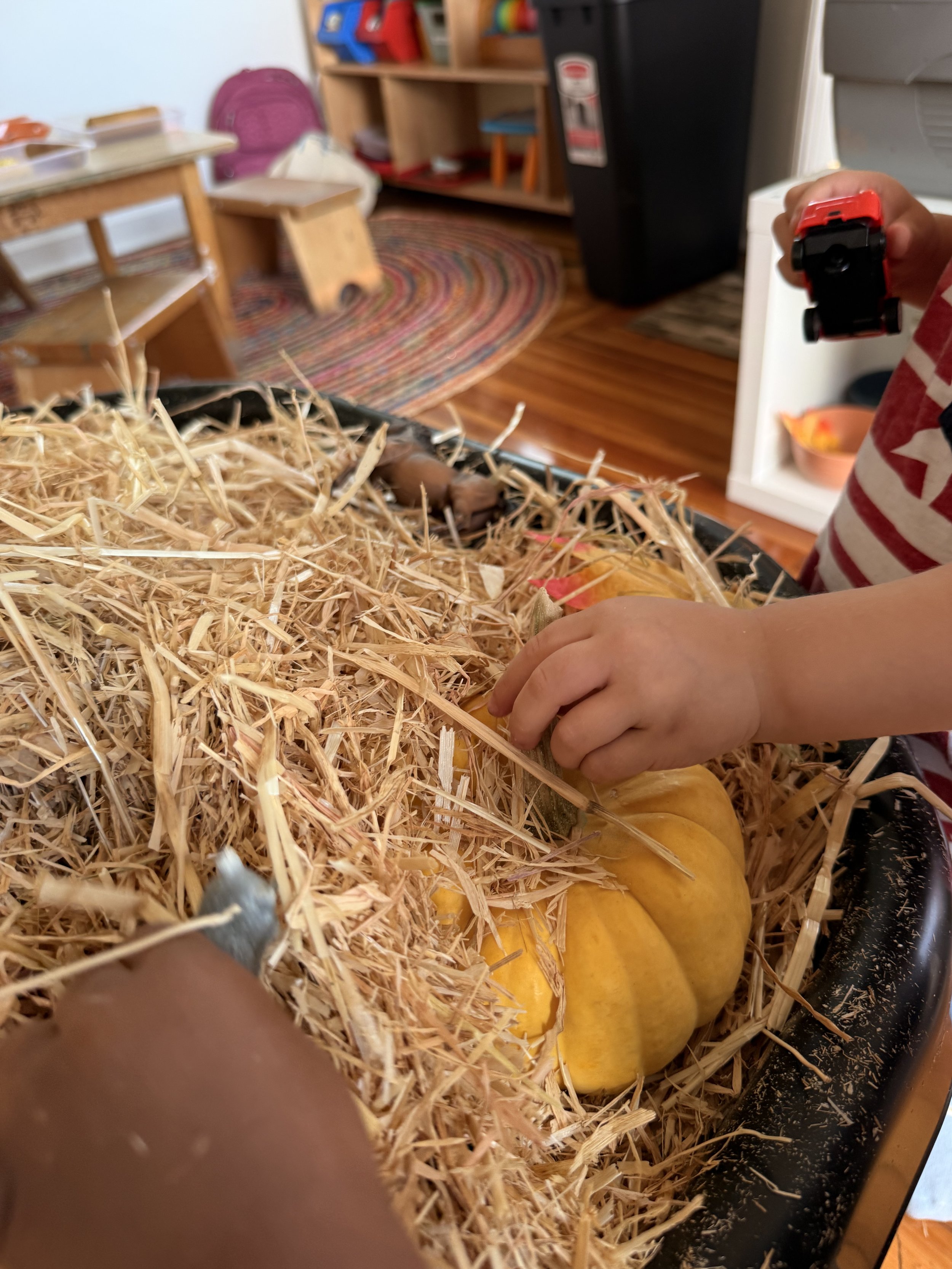
These exchanges revealed how differently the children were experiencing the same materials. While color initially captured their attention, their discoveries began to include weight, size, and the physical characteristics of each object.
Noticing the children’s growing interest, Jules posed a question:
“Do we notice any more pumpkins in the room?”
Suddenly, the investigation expanded beyond the Tuff tray. The children began moving through the atelier, searching shelves, baskets, and corners for more pumpkins. “I’m going to find the big ones and the little ones,” Bryce announced, already developing his own criteria for the search. Ciel joined the investigation, carefully collecting gourds from a nearby basket and bringing them to the table.
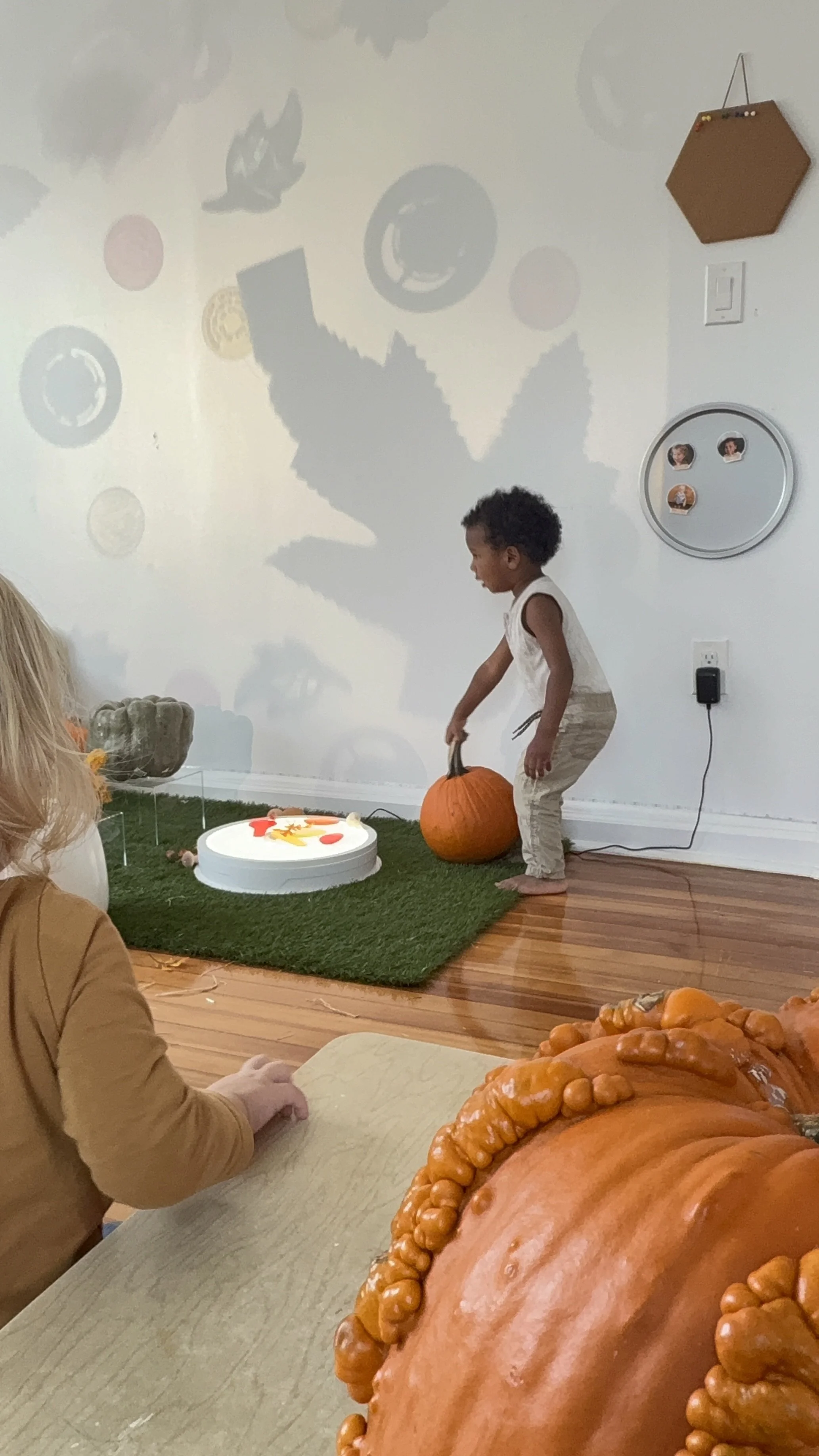
One by one, the pumpkins and gourds gathered in the center of our shared space.“All of them are gone!” Bryce declared, noticing that the pumpkins previously scattered throughout the room had now been collected. What began as a search for hidden treasures had transformed into an opportunity to gather, compare, sort, and observe.
With the pumpkins gathered, the children began examining their collection.“Orange!” “White!” “Green!” “Yellow!” The room filled with enthusiastic observations as the children identified the colors before them. But color was only the beginning.
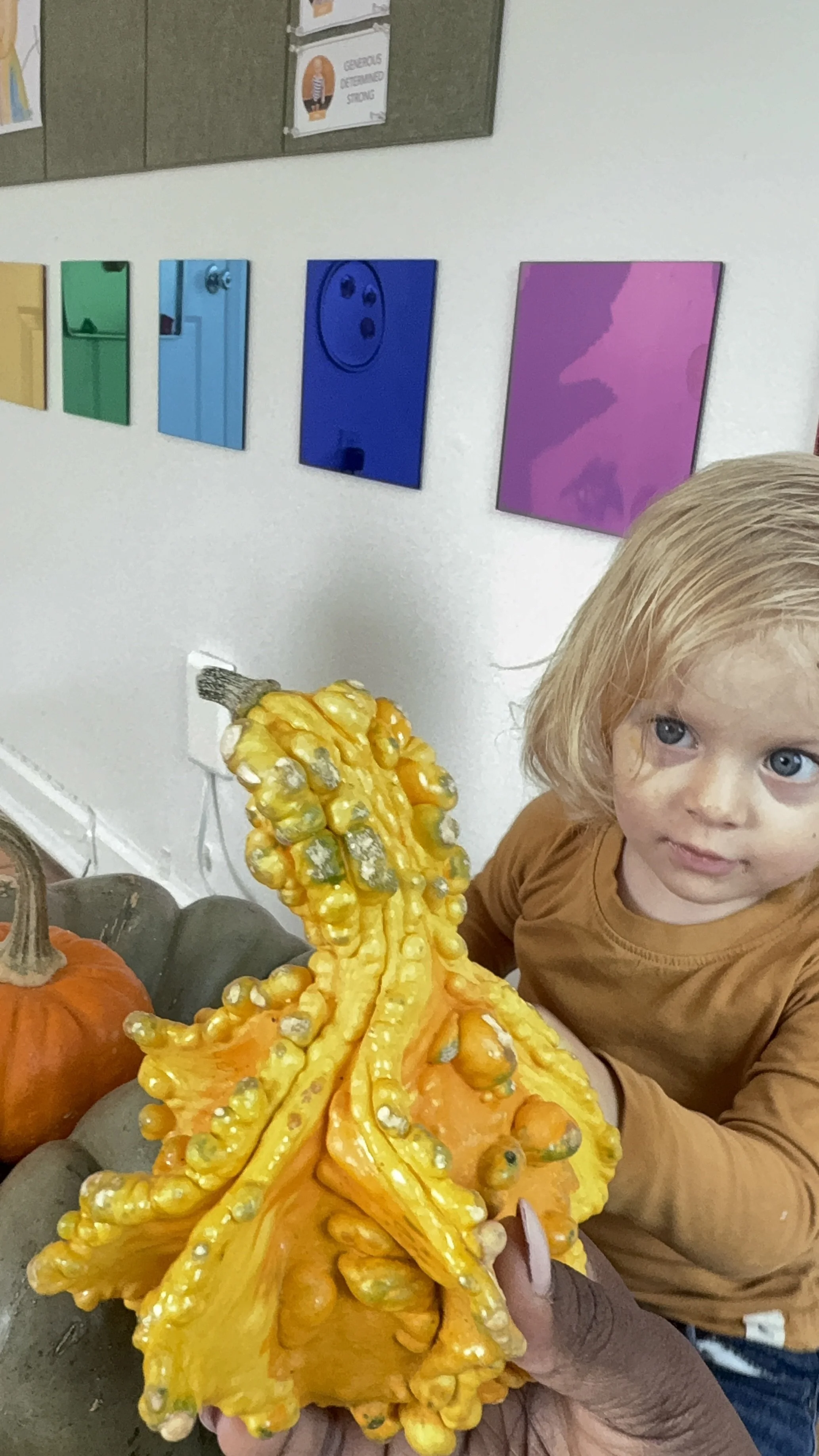
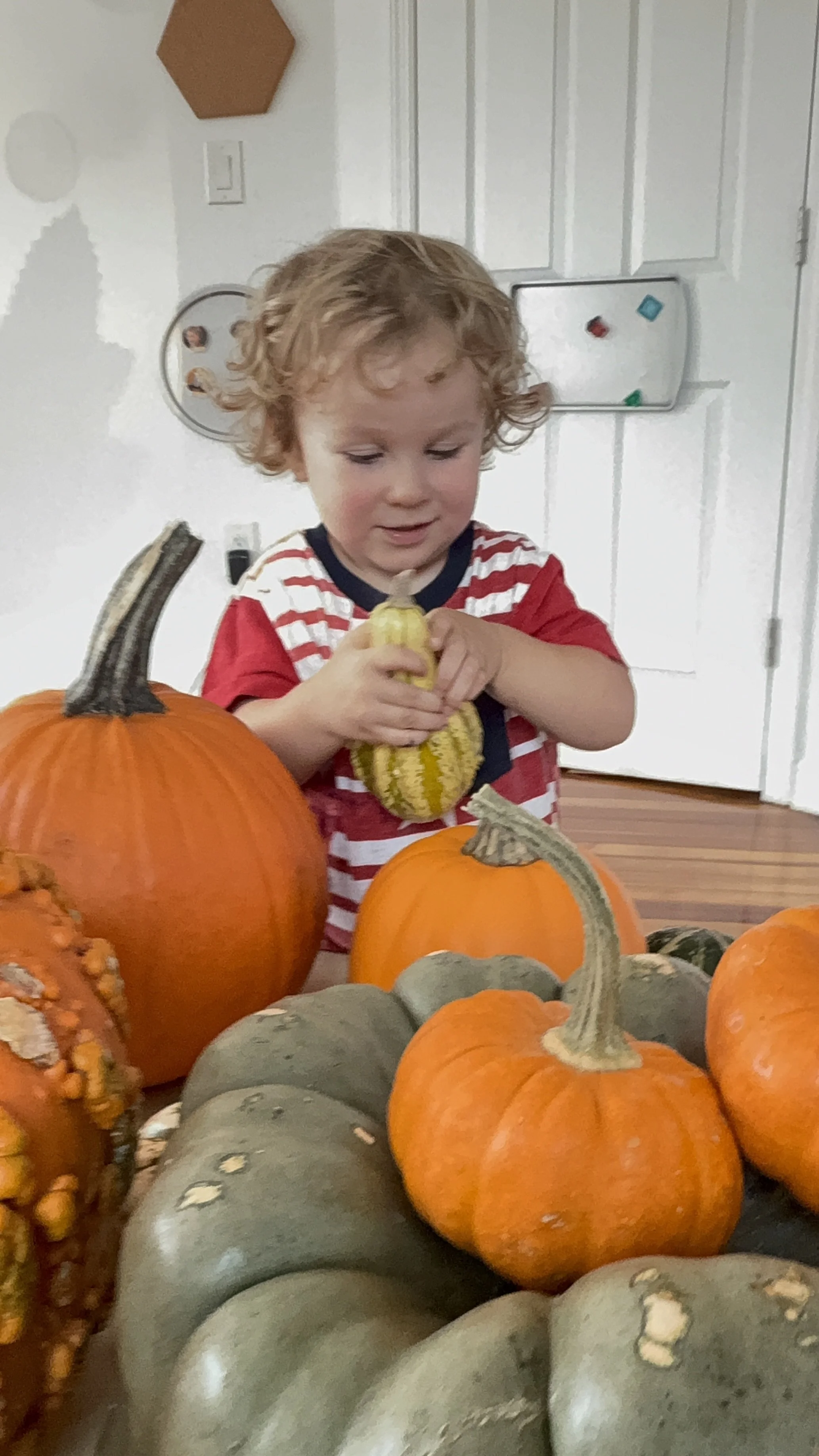
As their hands traveled across the surfaces of the pumpkins and gourds, we began noticing differences in texture. Some were smooth, others bumpy, and a few appeared to be both smooth and bumpy. Ciel reached for one of the bumpy gourds, drawn to its unusual surface.
We continued comparing the pumpkins by size: small, medium, and large. The children lifted, held, and examined them, noticing the qualities that made each one different.
Another question emerged: Which pumpkins were real, and which were pretend?
Together, we considered which ones could be eaten and which ones could not. Aden playfully brought an edible pumpkin toward his mouth, pretending to take a bite.
It was a small, delightful moment that connected our investigation to something familiar: food. The children’s understanding of pumpkins was becoming richer. These were no longer simply orange objects associated with autumn. Each pumpkin possessed its own characteristics, inviting careful observation and comparison.
After exploring the pumpkins with their hands, the children were invited to communicate their ideas through drawing. Paper and crayons were placed on the table, offering another language through which they could express what they had noticed.
Bryce moved his arm in a circular motion, creating a rounded form on the page.
“I’m coloring it in,” he explained as he continued working within his drawing.
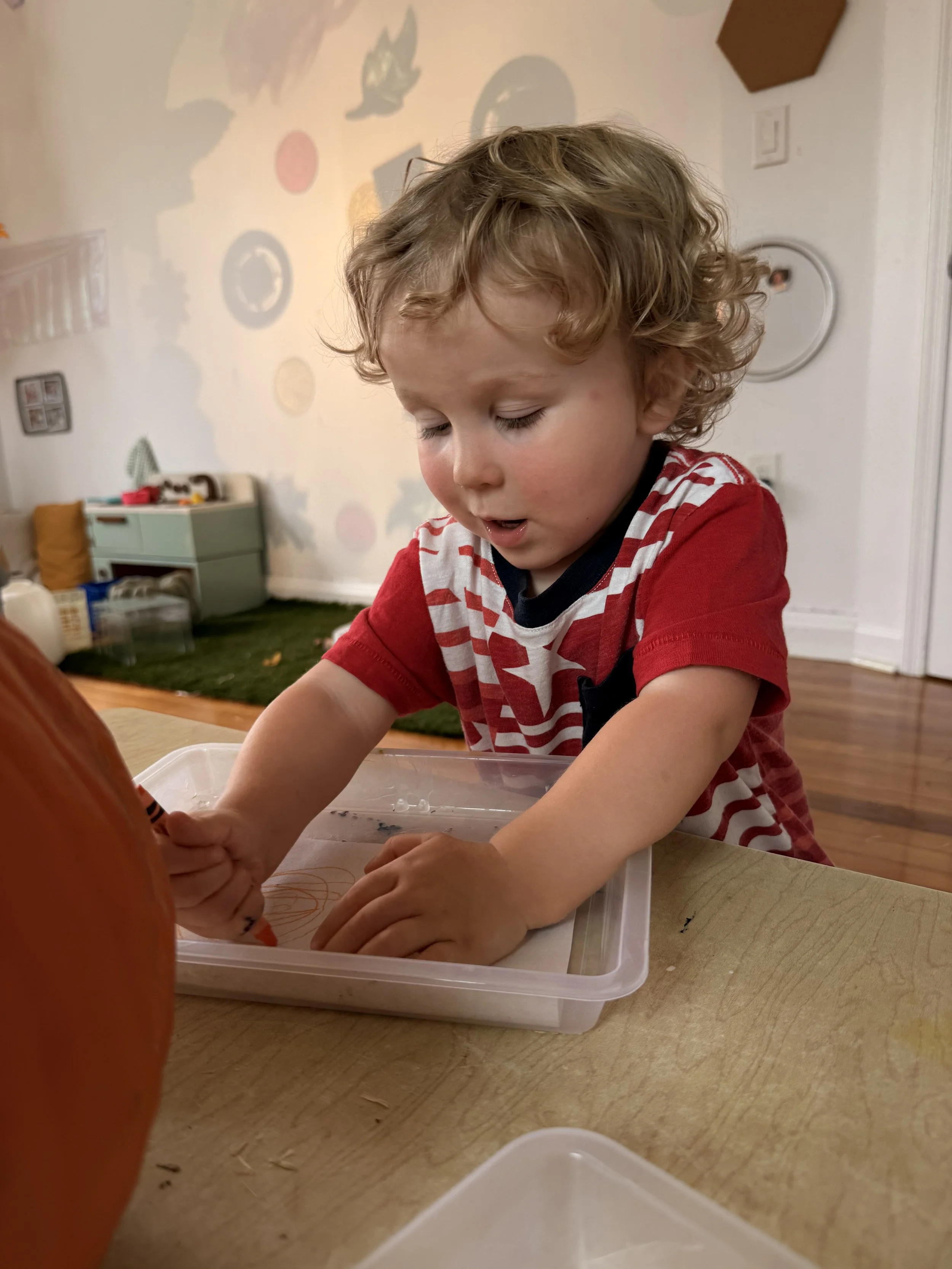
“I’m coloring it in,”
Ciel approached his representation differently. He drew circles and added lines, recalling the visible ridges that travel along a pumpkin’s surface. Aden made a pale circular form, using his marks to offer his own interpretation.
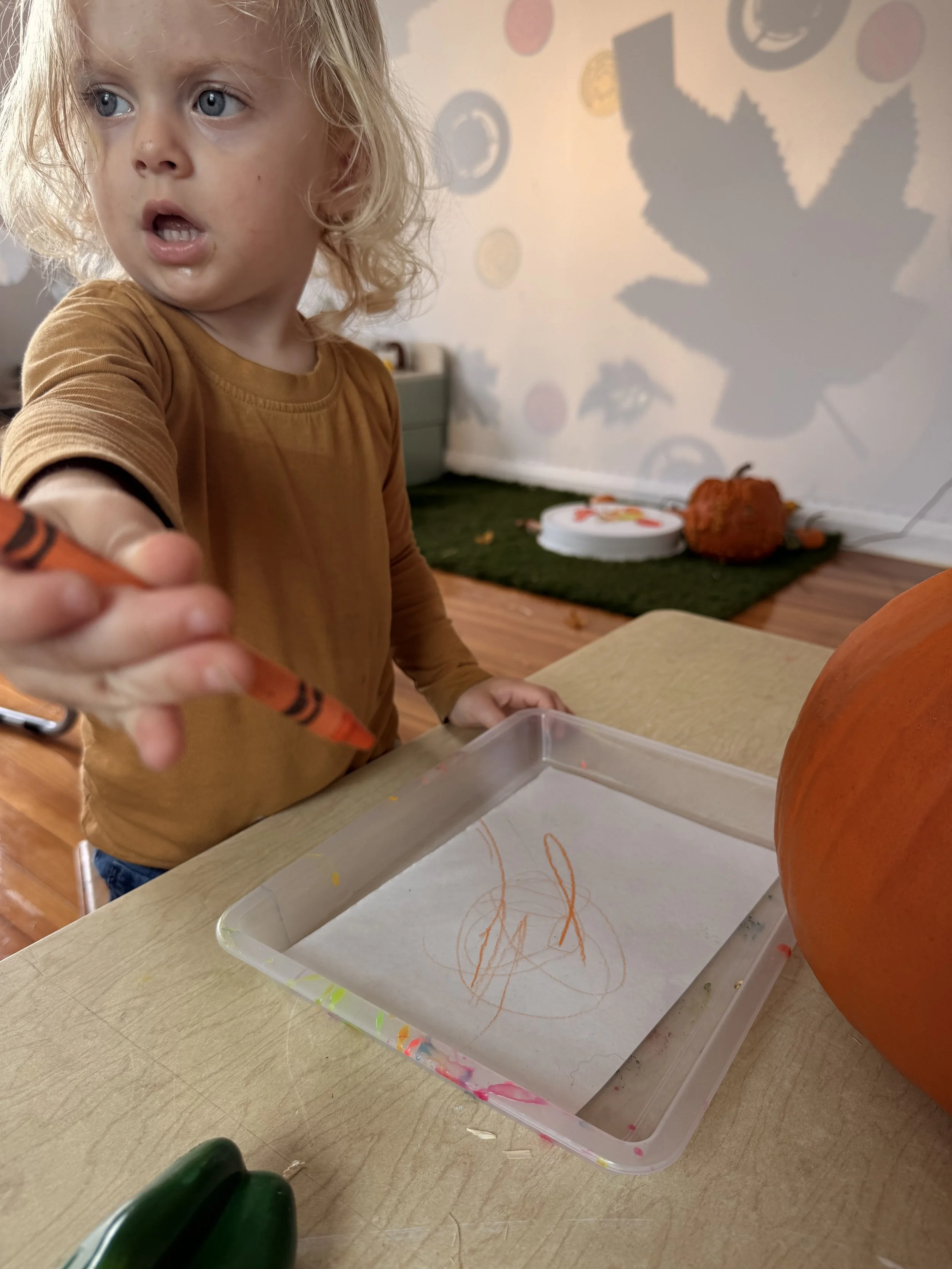
Each drawing was distinct. What interested us was not whether the children’s drawings looked exactly like pumpkins, but how they chose to represent their observations. Bryce’s circular movements, Ciel’s attention to lines, and Aden’s pale form gave us glimpses into what each child found meaningful. Through drawing, the children began translating their three-dimensional experiences into two-dimensional representations. These marks became traces of their thinking.
Our exploration continued with the introduction of a new material: air-dry clay. Jules placed a large lump of clay before the children and named the material. Before offering instructions or tools, she invited them to feel it. Small hands reached forward. Some fingers tapped against the surface. Others pressed firmly into the clay, leaving impressions behind. The children began testing how the material responded to their movements.
Then came a new invitation: Could they break the clay apart?
The children dug their fingers into the dense lump, pinching, pulling, and pressing. Breaking off a piece required persistence, and their excitement was evident when the clay finally separated.
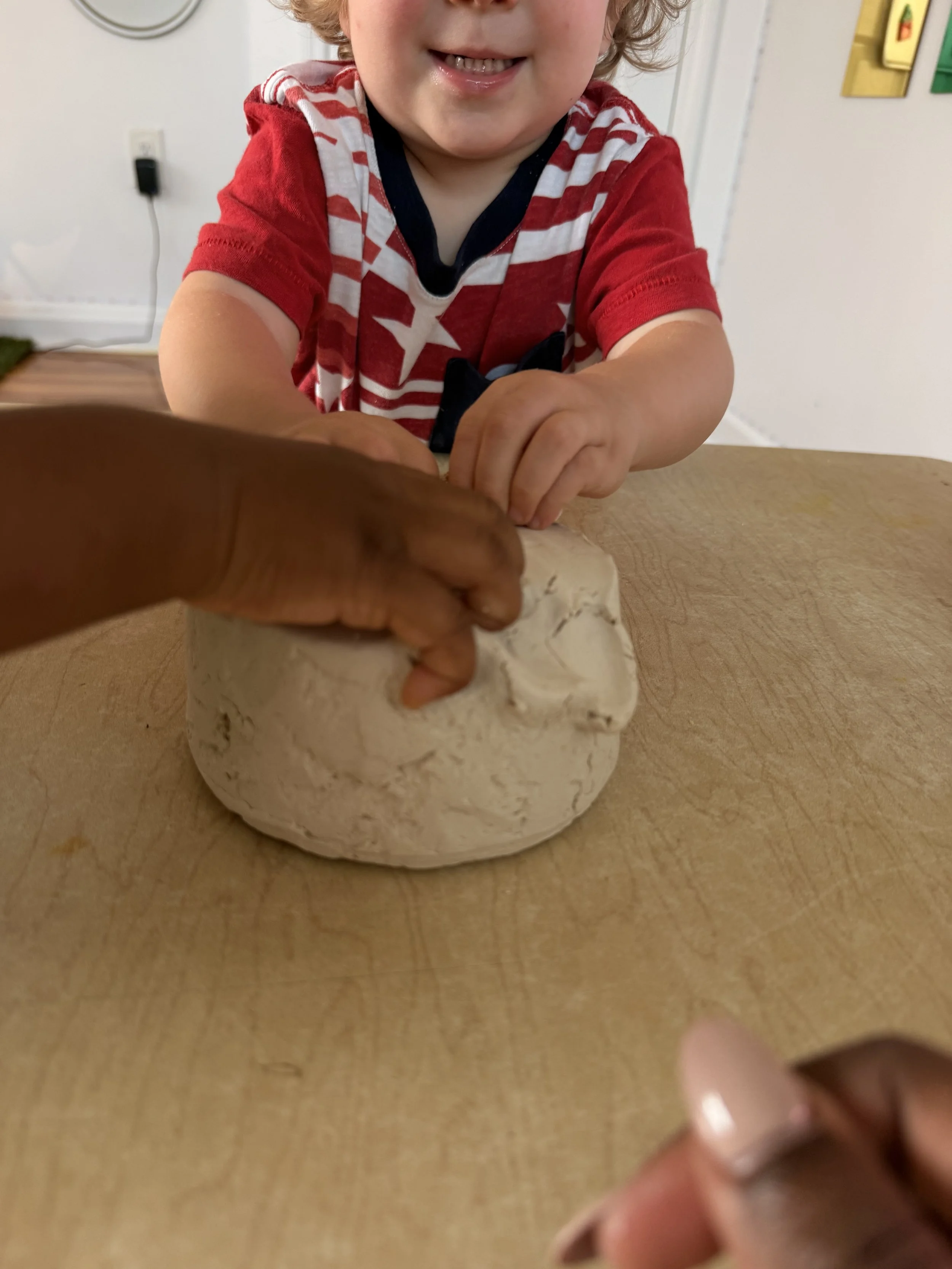
Aden approached the challenge with an unexpected idea. He picked up a pan and began banging it against the clay, experimenting with another way to break the material. Bryce observed Aden’s technique and requested a knife. Soon, each child had a tool to investigate the clay’s resistance. Ciel worked deliberately, taking his time as he sliced into the surface. Bryce and Aden continued experimenting with ways to separate the clay.
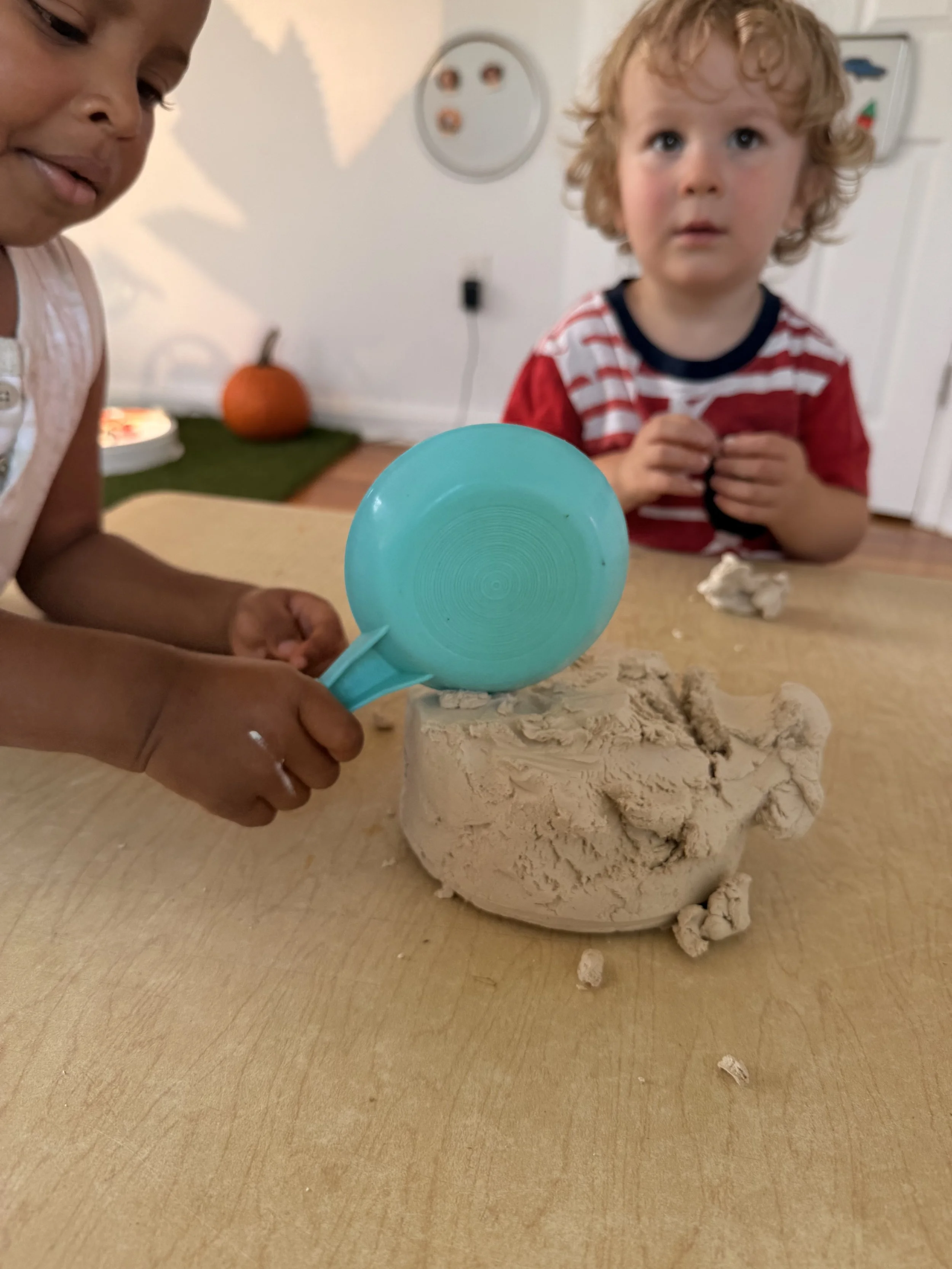
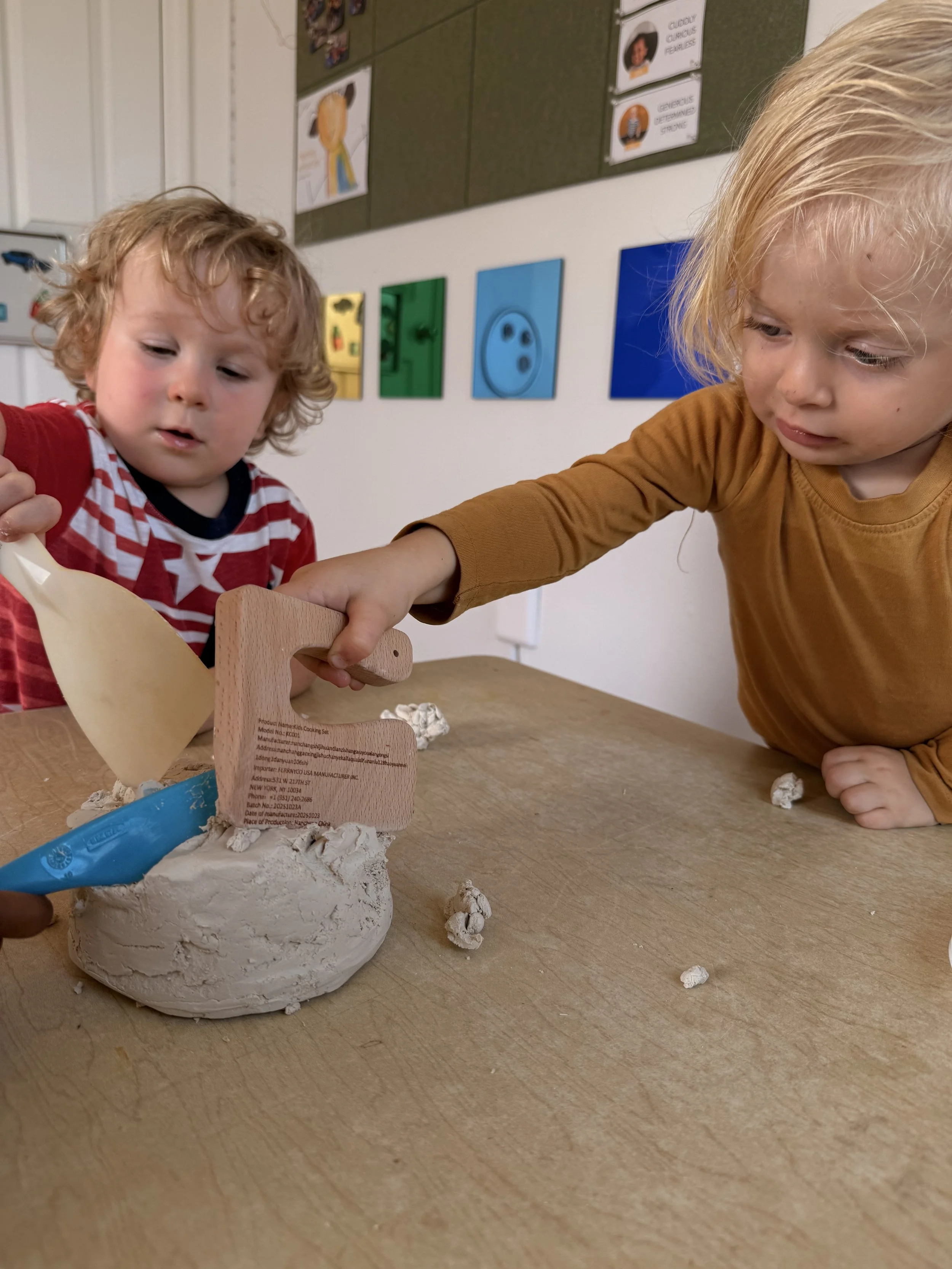
Rather than immediately intervening, we allowed space for the children to test their ideas, experience resistance, and discover what their actions could accomplish. Their approaches were different, yet each demonstrated curiosity, determination, and problem-solving. Eventually, each child successfully separated a piece of clay from the larger lump. Jules then introduced rolling pins, encouraging the children to flatten their individual pieces. The familiar action sparked a connection. Bryce remarked that the clay reminded him of playdough. Aden’s eyes widened in recognition. “Playdough!” he exclaimed. The children were connecting this unfamiliar material with something they already knew. Although clay and playdough share certain qualities, the children were beginning to experience how differently they respond to pressure, movement, and tools.
With their clay flattened, the children were invited to introduce color using markers.
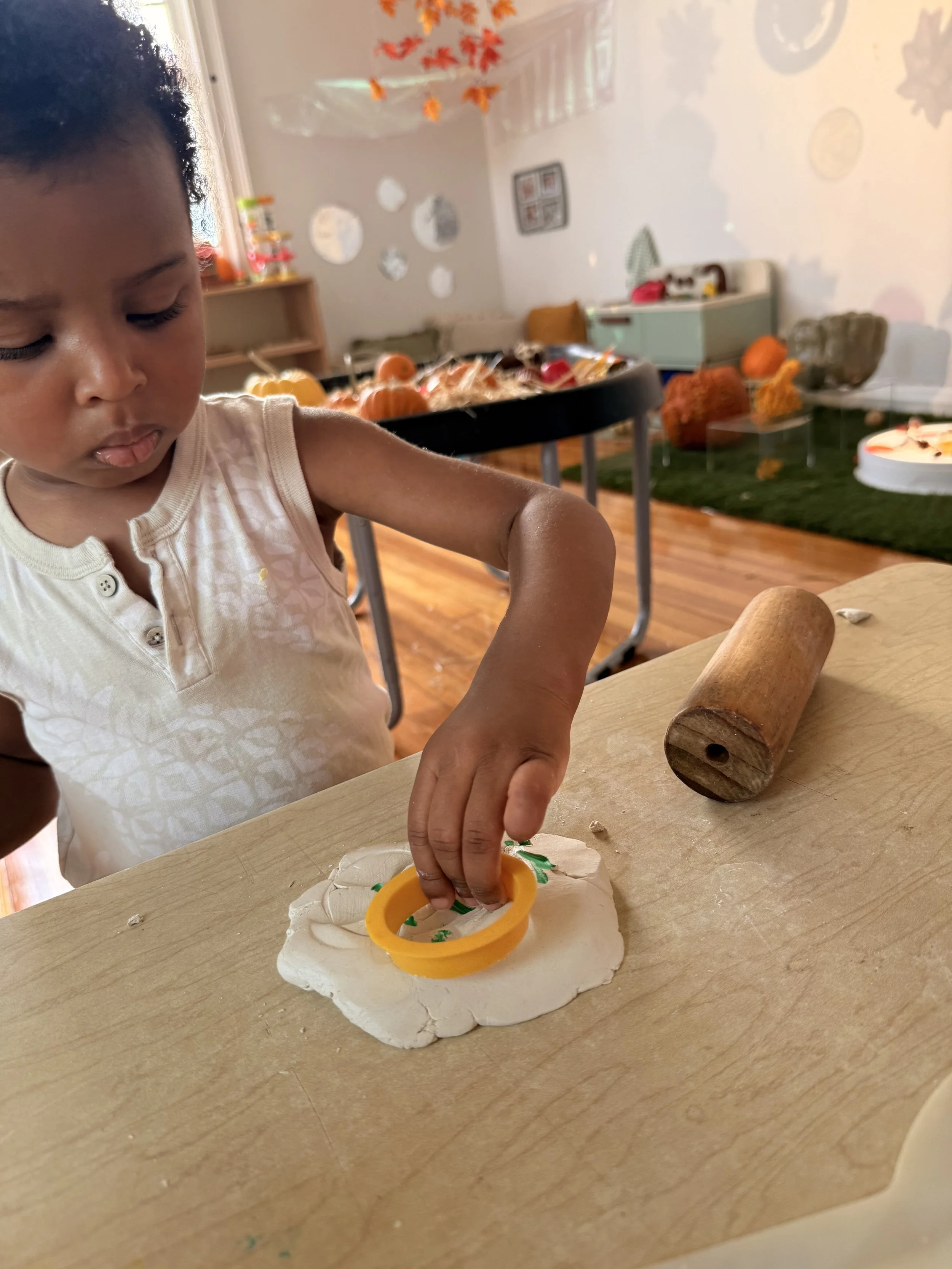
A circular cookie cutter offered a way to create rounded shapes inspired by the pumpkins they had observed.
The children pressed the cutter into the clay, transforming the flattened pieces into individual forms. Finally, tiny mosaic pieces were introduced. The children carefully placed the small pieces onto their clay pumpkins, adding color, texture, and detail. Each creation carried traces of its maker: the pressure of fingers, the marks of tools, the movement of color, and the placement of mosaics. The pumpkins were then left to dry. Our exploration had moved from discovering pumpkins hidden in hay to observing real objects, representing them on paper, and finally creating new forms through clay.
What began as an invitation to explore autumn materials became an investigation shaped by the children’s own discoveries. It was especially interesting to observe how one child’s attention could influence another’s. Bryce noticed the hidden objects, Aden joined his search, and Ciel contributed by gathering gourds. Their individual interests gradually became part of a shared exploration.
We also noticed how familiar experiences informed new ones. A pumpkin became a subject for comparison, a drawing became a way to communicate observation, and a lump of clay prompted memories of playdough.
The most meaningful moments were not necessarily the finished clay pumpkins, but the discoveries that happened along the way: Aden recognizing something as light, Bryce noticing the weight of a large pumpkin, Ciel examining a bumpy surface, and each child finding their own way to break apart a resistant piece of clay.
These moments remind us that children’s learning is rarely linear. It moves between observation, movement, conversation, experimentation, and representation.