
Sometimes, as adults, we feel the need to introduce something new. A different activity, a new material, or another experience to keep children engaged. But children often remind us that there is so much more to discover in what they’ve already encountered.
Repetition is an important part of early childhood learning. Children may return to the same materials several times, yet their investigations are rarely exactly the same. With each encounter, they become more familiar with how the materials work, notice details they may have overlooked, and begin building upon their previous discoveries.
Today was a beautiful reminder of this.
This morning, the children returned to the same provocations from the previous day. At the table, clear acrylic boxes rested on a reflective mirror surface, offering opportunities to explore transparency, reflection, and arrangement. Nearby, the Tuff tray held our familiar combination of baking soda, watercolor, and vinegar, with pumpkins and gourds scattered across the paper. The environment was intentionally left much the same.
I was curious to see whether the children would return to their earlier investigations or find something entirely different to explore.
As it turned out, they did both. Bryce approached the Tuff tray and reached for his favorite color, blue. He carefully picked up the pipette and began releasing the blue vinegar mixture onto a yellow pumpkin. Tiny bubbles appeared across its surface. He paused. Then, slowly, he tried again. More bubbles formed.
There was something beautiful about watching him take his time. Unlike the excitement that often accompanies a new discovery, Bryce seemed interested in understanding what was happening.
He observed the reaction quietly, almost as though he were testing a theory. “There’s a lot of bubbles,” I said, drawing attention to what was happening. Bryce looked back at me and nodded before returning to his investigation. He continued adding liquid, pausing between each attempt to observe the reaction.
As the vinegar reacted with the baking soda, a soft fizzing sound emerged. Bryce noticed it and gave a small smirk. “There’s more bubbles,” he commented confidently. I was especially interested in the shift from his initial quiet observation to his confident statement. Through repetition, Bryce appeared to be developing a clearer understanding of how his actions could produce the bubbling reaction.
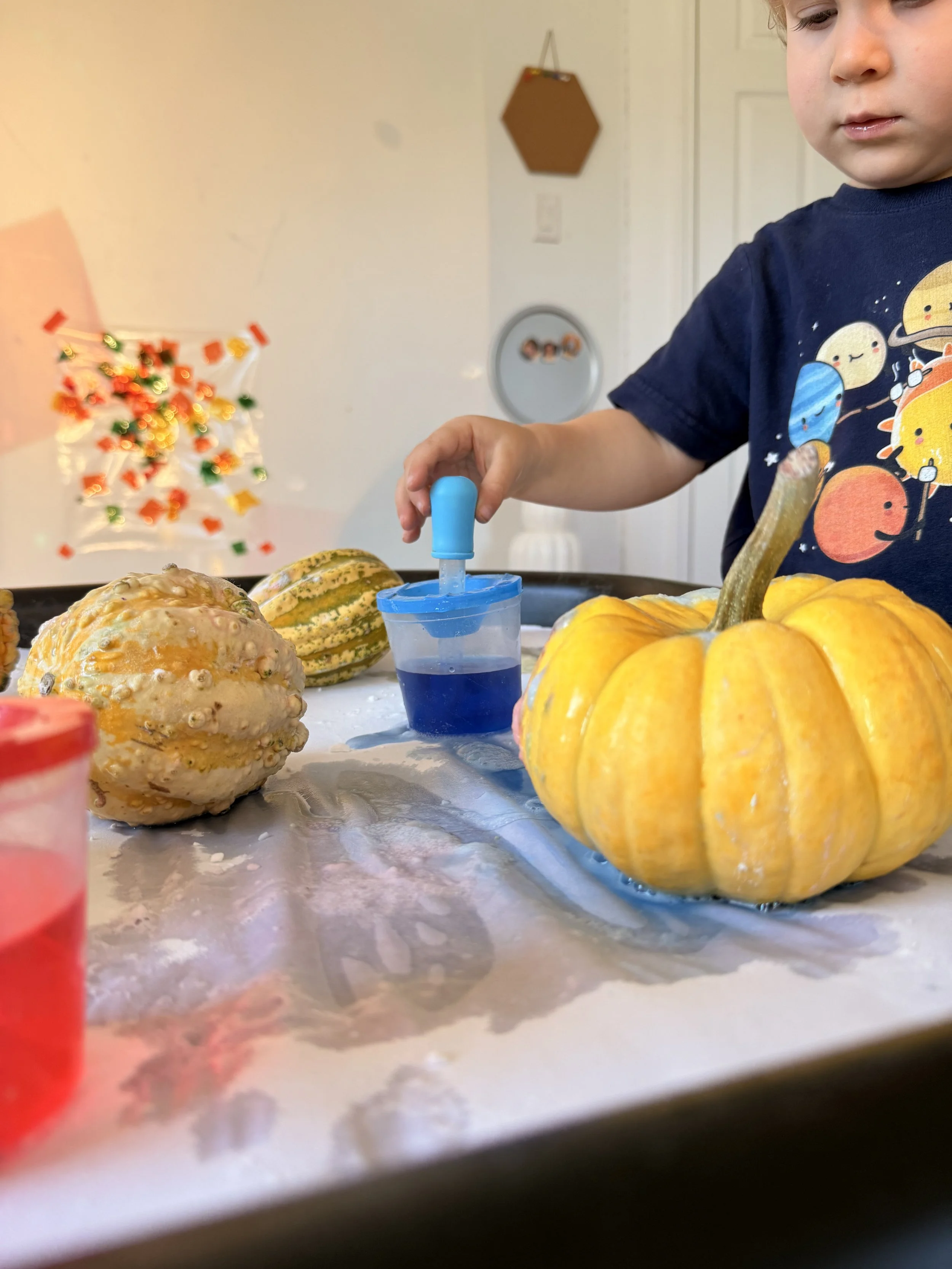
Nearby, Aden was already familiar with the process. He picked up a pipette and began squirting the mixture onto the pumpkins and slowly across the paper. “Bubbles!” he exclaimed. His excitement felt familiar. Having encountered the reaction the previous day, Aden seemed to recognize what was happening almost immediately.
While Bryce carefully observed and tested the reaction, Aden approached it with the confidence of someone returning to a familiar experience. Both children were investigating the same materials, but their approaches reflected their own interests and experiences.
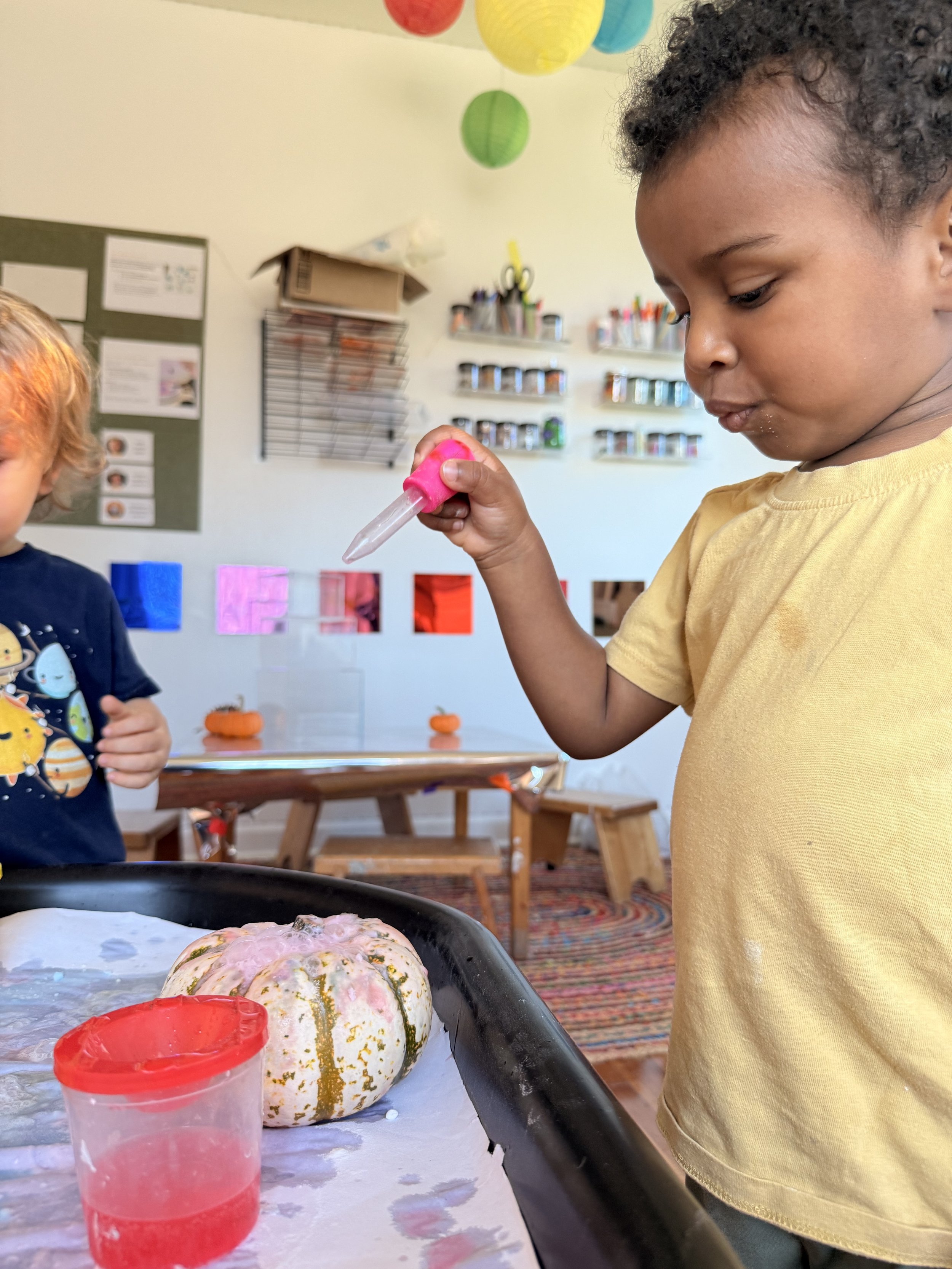
As the exploration continued, the children’s attention gradually shifted. The pumpkins and gourds, which had initially served as surfaces for the bubbling reaction, began moving aside as the children became increasingly interested in the colors spreading across the paper. Bryce started experimenting with the watercolor directly. He selected the yellow liquid and carefully added it to the blue mixture. Drop by drop. He watched as the colors combined. When he drew some liquid into the pipette, he noticed something unexpected. The mixture had turned green! Rather than stopping there, Bryce continued experimenting. Once the blue cup was empty, he turned his attention to the red liquid, slowly adding more color to the mixture. Again, he worked with intention. A little at a time, he added drops, observed the changes, and continued mixing. Then he looked at the color he had created. “I made maroon!” he exclaimed.
I began narrating how the different colors had come together, pointing out the red, yellow, and blue that had contributed to the new shade.
Bryce proudly continued squeezing his newly created “maroon brown” watercolor onto the paper. What stood out to me was how deliberate his actions had become. He was no longer simply transferring liquid from one place to another. He was experimenting with combinations, watching for changes, and giving names to the colors he created. The pipette had become a tool for much more than making bubbles.
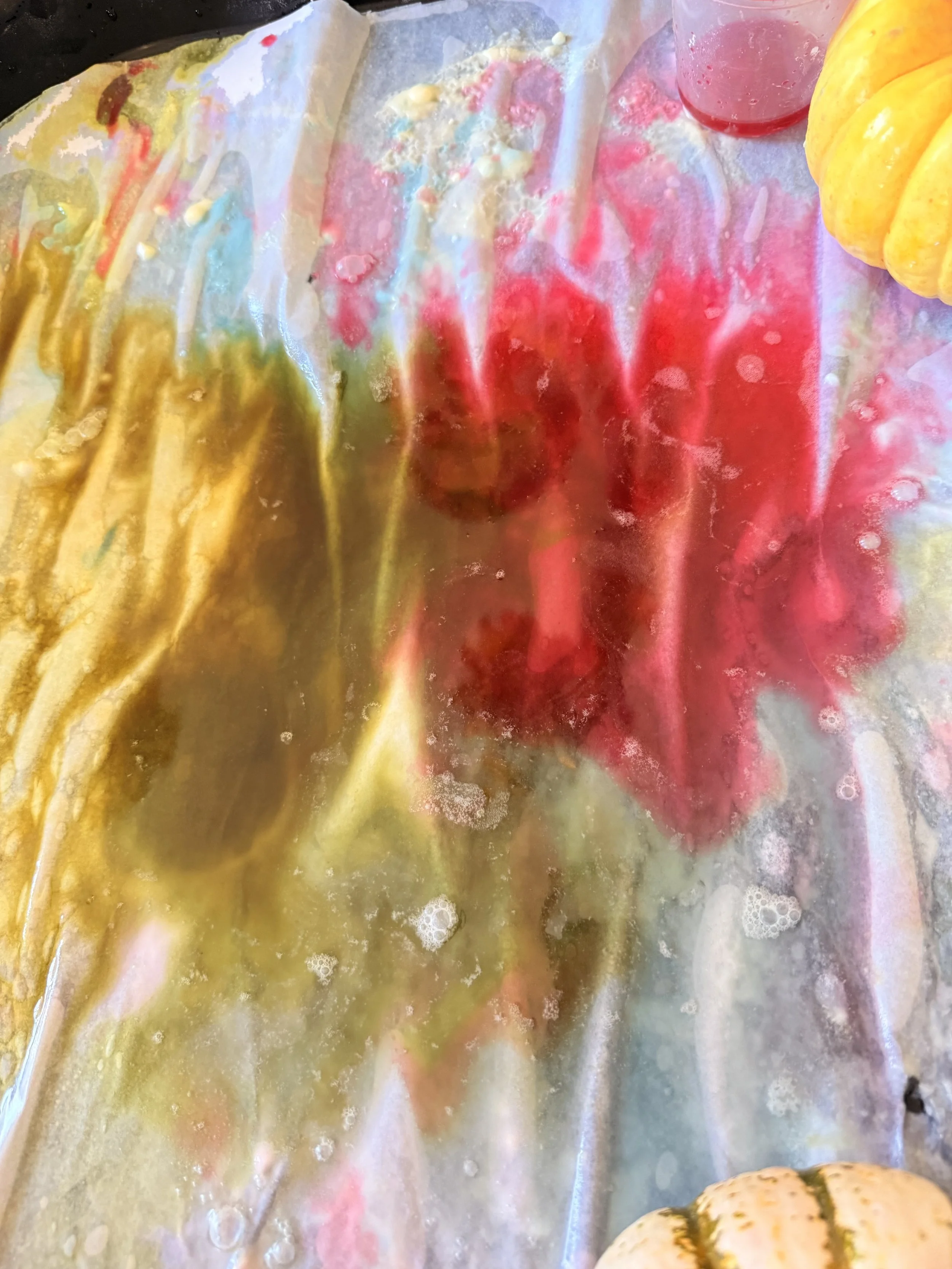
As we continued talking about the maroon-brown color, Aden made an unexpected connection. “Mud!” he exclaimed, pointing toward the mixture. To Aden, the color and appearance of the watery paint resembled something familiar. And mud, of course, meant something his cars could drive through.
Without hesitation, he left the Tuff tray to find one of his toy cars. When he returned, he began moving the car across the colorful paper, driving its wheels through the watery mixture. As the car traveled across the surface, the colors spread and blended even further.
What had begun as an investigation of chemical reactions had now become an imaginative experience inspired by something from Aden’s world. Then Aden did something particularly thoughtful. He went to retrieve another car for Bryce. “Thank you, Aden,” Bryce responded.
With his new car in hand, Bryce immediately began pouring blue liquid over it, finding his own way to participate in the emerging investigation.
I loved this moment.
Aden had introduced an idea, invited Bryce into it by bringing him a car, and together they began exploring a new possibility with the same materials. Their play was becoming a shared investigation, shaped by both children’s contributions. As I watched the children’s interest shift toward the cars, I realized the original arrangement was no longer serving the direction of their exploration. The pumpkins and gourds had become secondary to their new ideas.
So I removed them, along with the color-covered paper, creating more space on the Tuff tray. I introduced a few wipes, curious to see how the children might use them. The wipes offered a new surface for absorbing color while also providing something they could use to clean their cars. Almost immediately, the children began experimenting. Aden focused on washing the “mud” from his cars. He moved between the colorful water and the wipes, exploring the process of getting his vehicles dirty and cleaning them again. Bryce discovered something different. As the watercolor spread across the wipes, he noticed how the colors blended into one another. The patterns reminded him of something familiar. A tie-dye shirt! He explained that he had one at home. With this connection in mind, Bryce began adding and mixing colors on the wipes, creating his own tie-dye-inspired patterns.
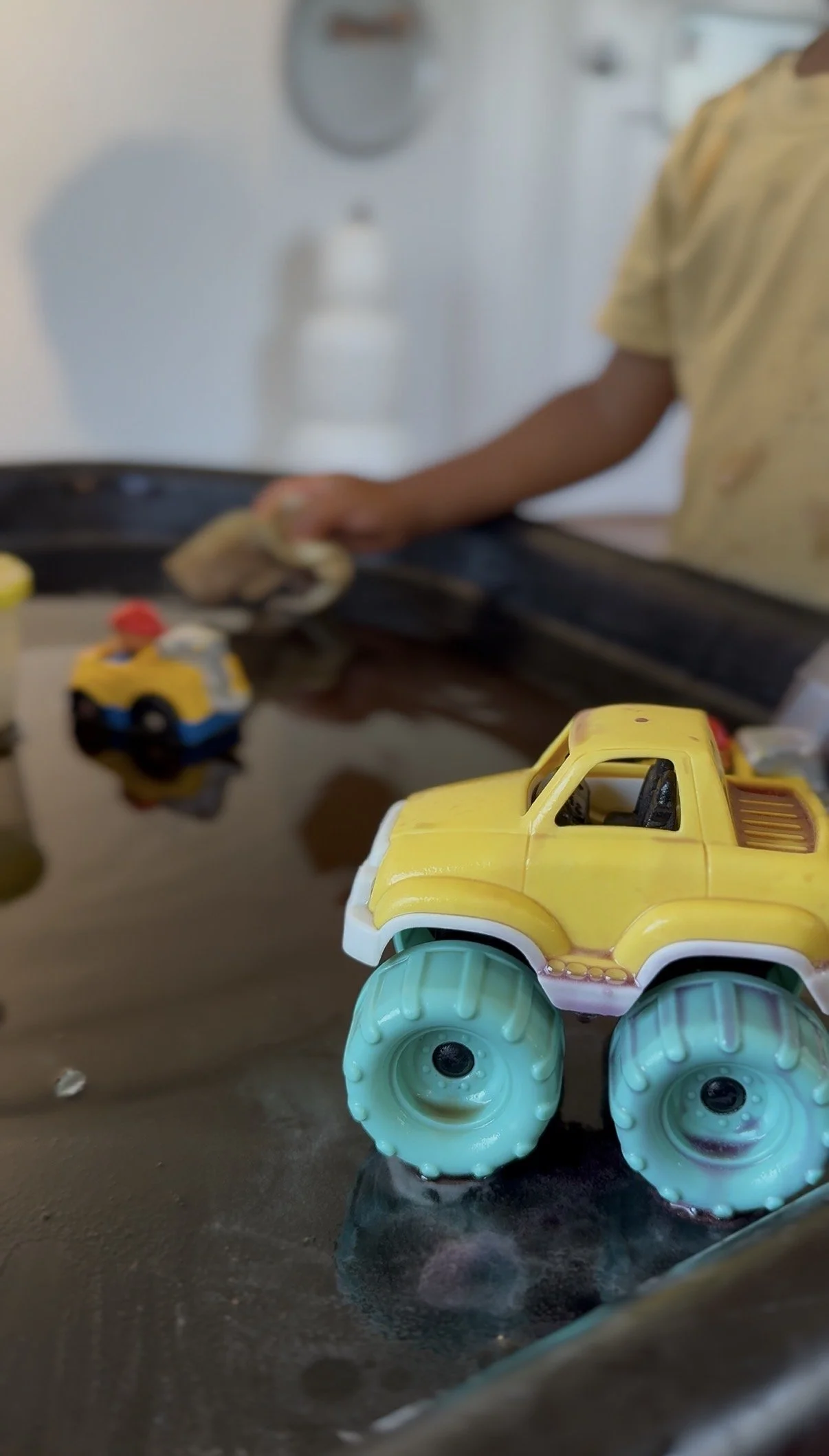
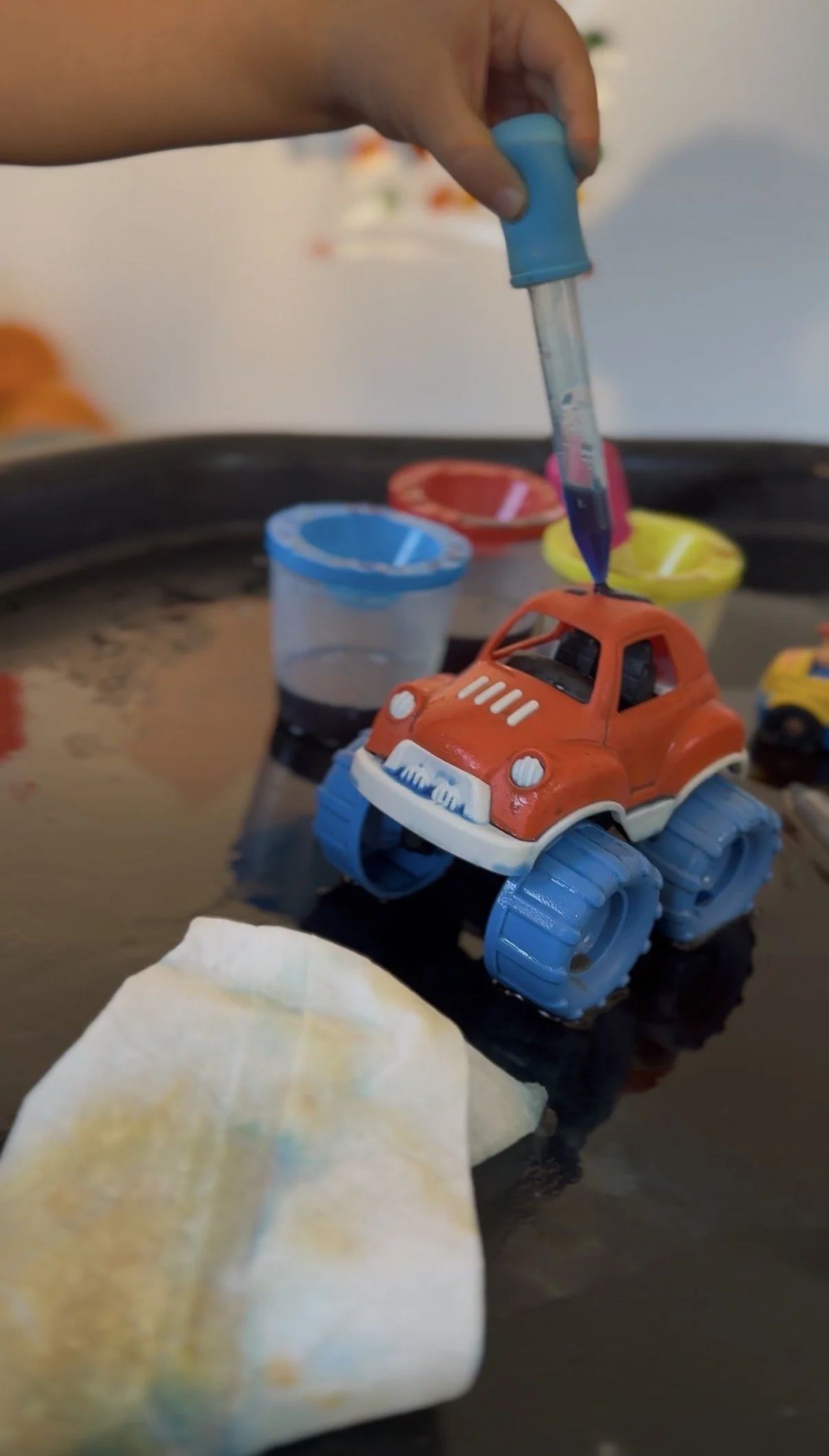
I found this particularly meaningful because the same material was being used in two entirely different ways. For Aden, the wipes became tools for washing. For Bryce, they became surfaces for artistic exploration. Neither child needed to be shown what to do. They drew upon their own experiences, interests, and observations to give purpose to the materials.
Can I tell you that the children spent an entire hour exploring this one provocation?
An hour!
What began with bubbles developed into color mixing, imaginative mud play, car washing, and tie-dye-inspired creations. And the most interesting part was that none of those directions had been planned.
I had prepared the environment with the intention of extending the children’s understanding of cause and effect through a familiar chemical reaction. But the children saw possibilities beyond my initial intention.
They took their time.
They revisited ideas.
They noticed changes.
And with each discovery, they found another reason to continue. As adults, we can sometimes feel finished with an experience long before children are. We may see that the bubbles have formed, the colors have mixed, and the initial objective has been met. But children may only be beginning to understand what is possible.
There was a moment during this exploration when I could have stopped the children. When Aden returned with his car, I could have redirected him back to the pipettes, pumpkins, and baking soda.
After all, the provocation had been prepared to investigate bubbles and chemical reactions, not to wash cars or create muddy roads.
But why would I?
The car wasn’t a distraction from the learning. It was an extension of it. Aden had made a connection between the brown watercolor and mud. He was bringing something familiar from his own experiences into the investigation. Bryce, meanwhile, was developing his own ideas about color, eventually connecting the patterns on the wipes to his tie-dye shirt at home.
Had I insisted that the children use the materials only as I originally intended, I would have missed these moments.
Sometimes, children are willing to stay with an idea much longer than we expect, especially when they have the freedom to make it their own.
This experience reminded me why repetition is so valuable in early childhood. When children revisit materials, they are not necessarily repeating the same learning. They may be testing earlier discoveries, developing new ideas, or noticing possibilities that were not apparent during their first encounter.