
“Why is the room so dark?”
Entering the Darkened Room
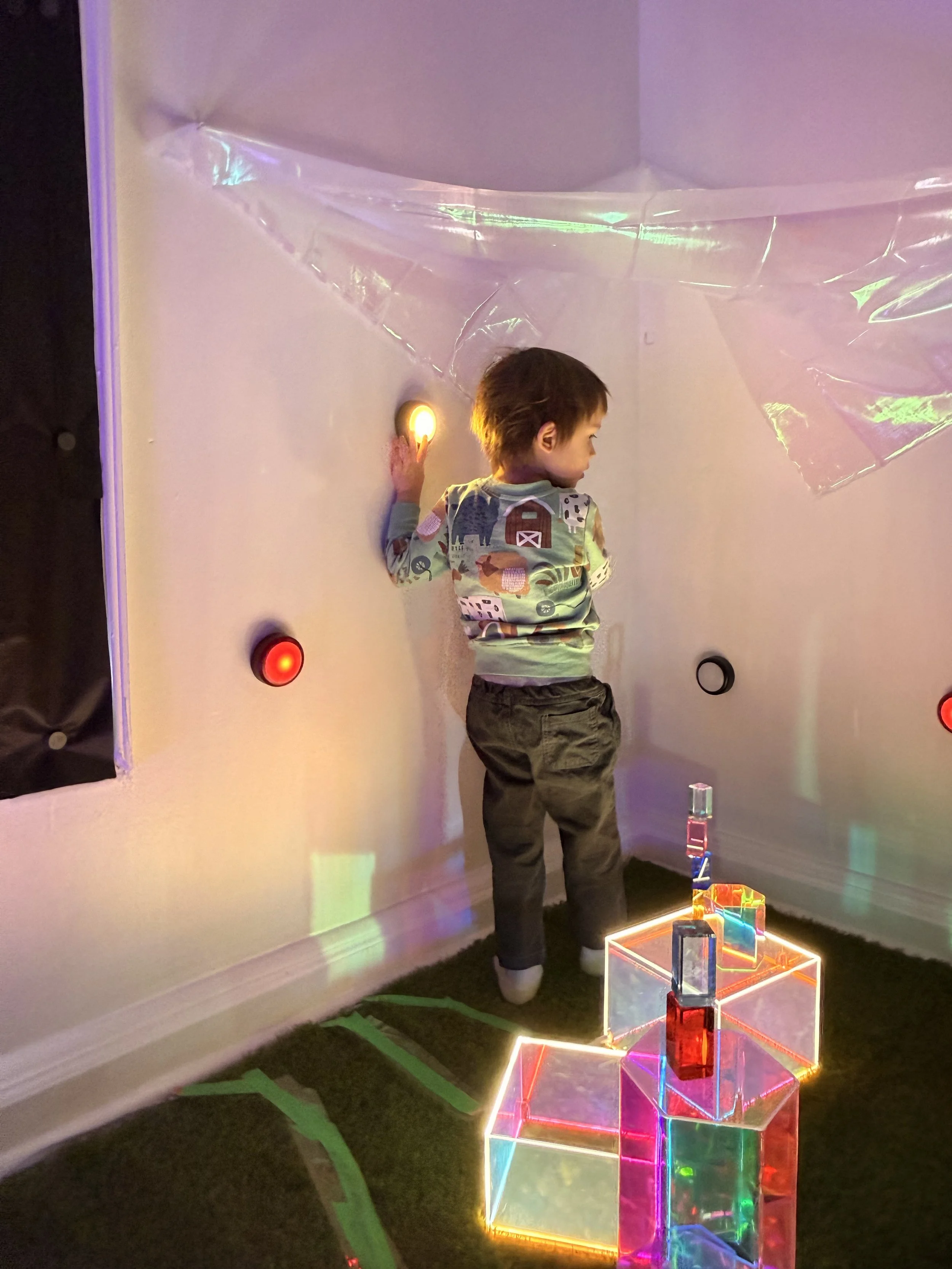
As the children arrived, they immediately noticed the change in the environment.
Gigi paused and asked, “What happened to the room?”
Theo wondered aloud, “Why is the room so dark?”
Mateo confidently responded, “We turned off the light, and then we added all these things. That’s why.”
Julie invited the children in. They lingered for a moment, looking, noticing, taking in the space, before beginning to engage with the materials.
First Explorations
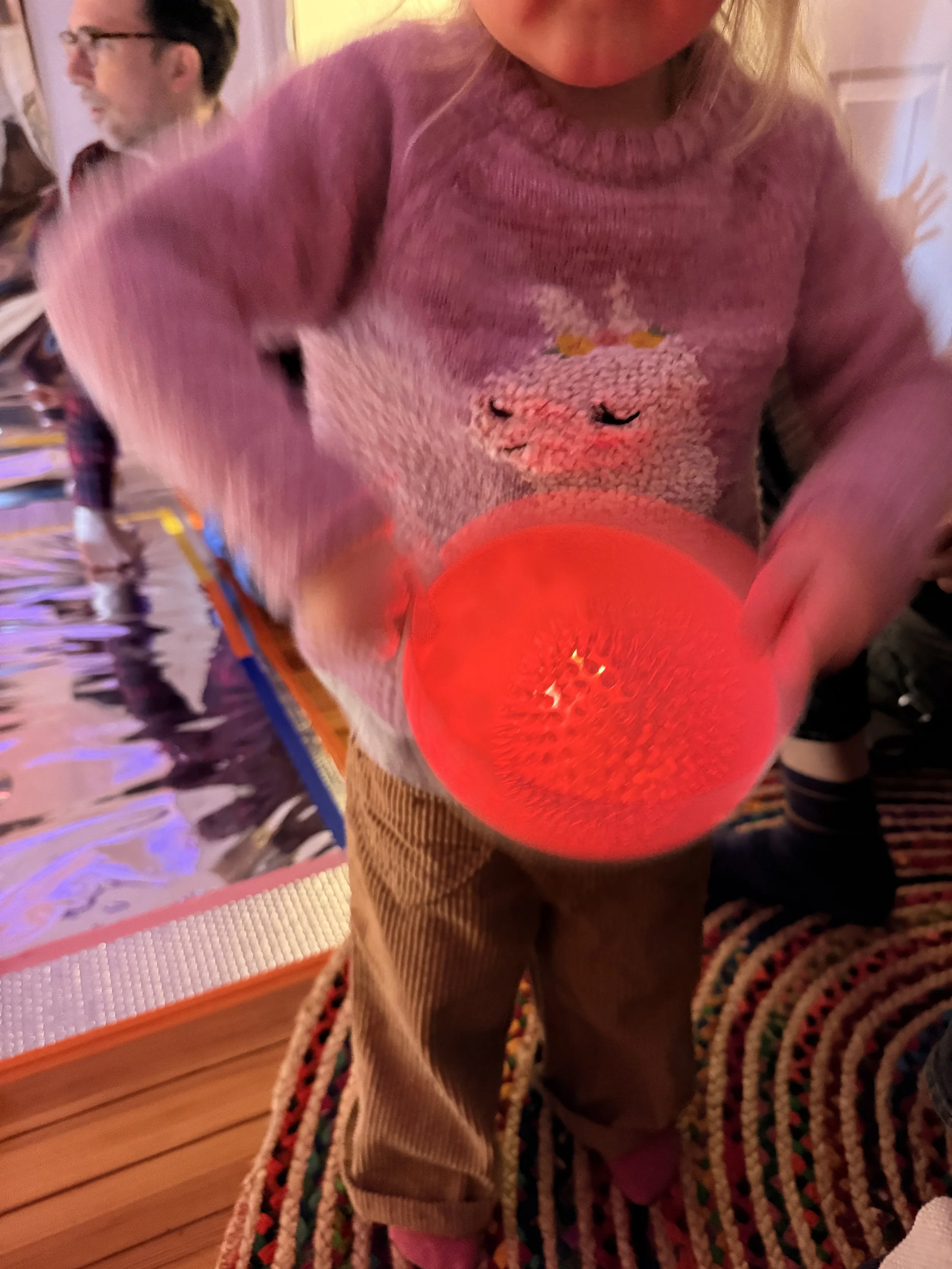
Gigi picked up a bowl holding a light-up ball and, with the support of her grown-up, began to shake it. As the bowl moved, the light flickered. She watched closely, captivated by the relationship between motion and light.
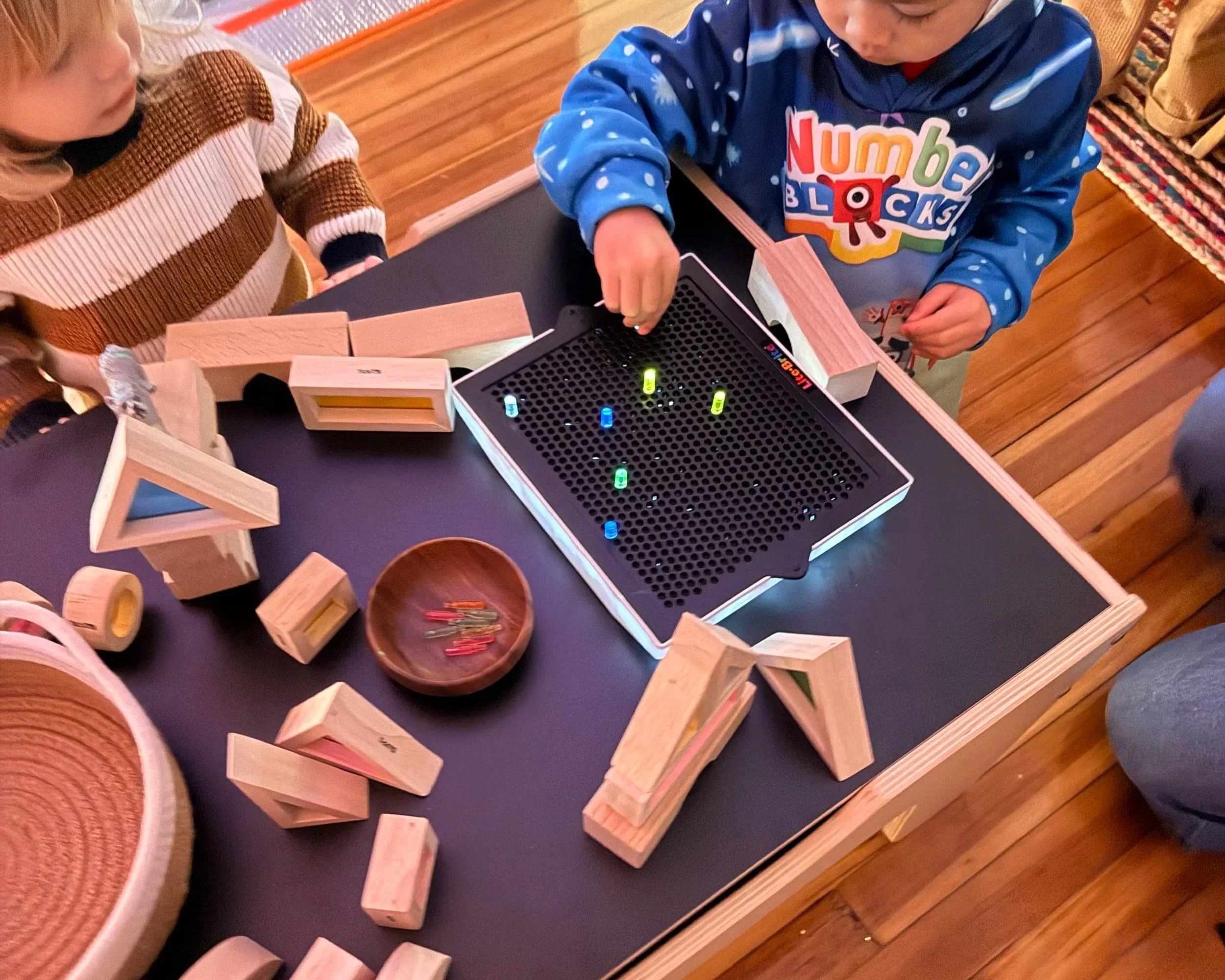
Next, Julie invited Noah and Theo to explore the Lite-Brite. She offered them pegs and encouraged them to place them into the holes. To their surprise, each peg lit up as it was inserted, turning their small actions into bursts of color.
Across the room, Aksel moved directly toward the spinning light table. He discovered the dinosaurs, familiar from the previous session, and carefully laid them out on the floor. As he worked, he created stories, naming each tiny dinosaur.
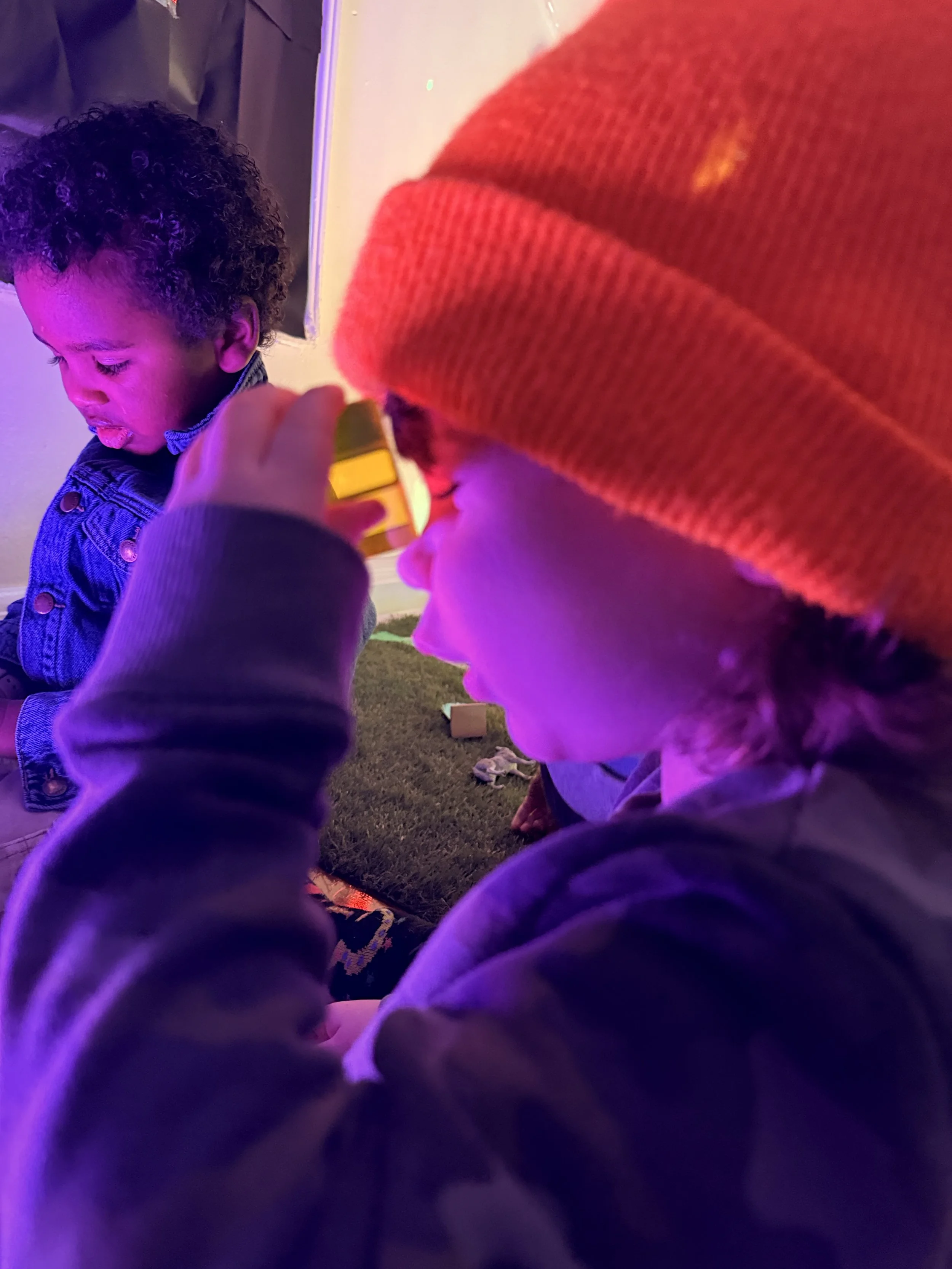
He then held a yellow stacking gem up to his eye, momentarily shifting his view of the world into shades of yellow.
Building Stories With Light
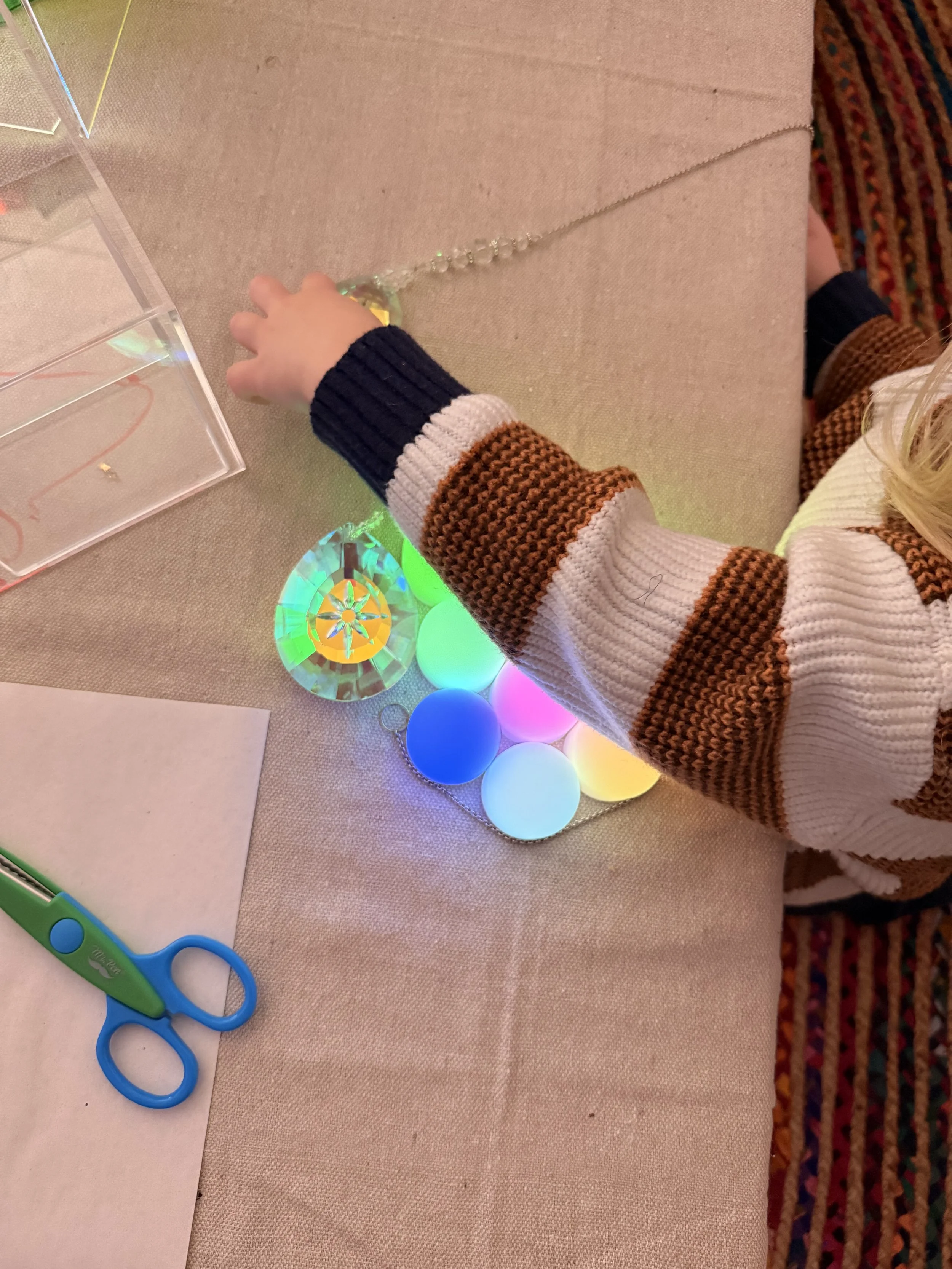
Mateo and Theo worked together stacking acrylic boxes and placing light-up balls inside, carefully balancing them to create a tower and hiding the “eggs” within. Theo later moved to the table, stacking the acrylic boxes vertically and placing small lights between each layer.
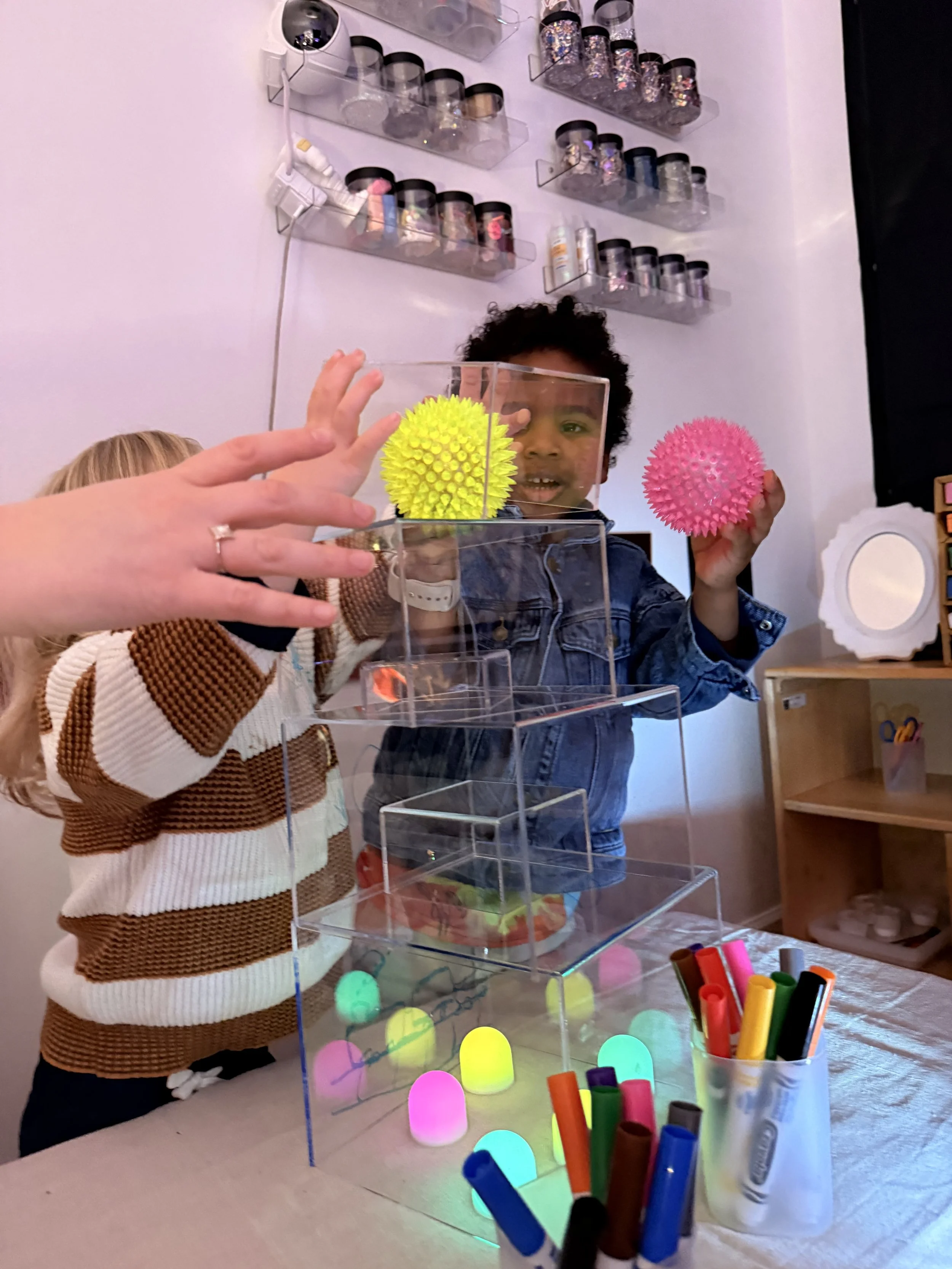
He picked up a prism, sliding it upward like a snake climbing. “My snake is looking for his eggs,” he explained. He gathered the lights, lined them up around the table, and circled the prism around the eggs. He then shared, with confidence, that “the eggs will open in twelve weeks.”
Introducing the Projector
The children grew curious as Julie brought out an unfamiliar machine, the overhead projector. As she plugged it in, the room brightened, and reflections appeared on the wall. The children quickly noticed themselves reflected back, their movements magnified.
Gigi immediately returned to a theory she had been developing from the previous week. She searched for a shiny bow and placed it over the projector’s light source. The wall went dark. She tried again. Darkness returned. She turned the projector off, darkness. She turned it back on and smiled knowingly.
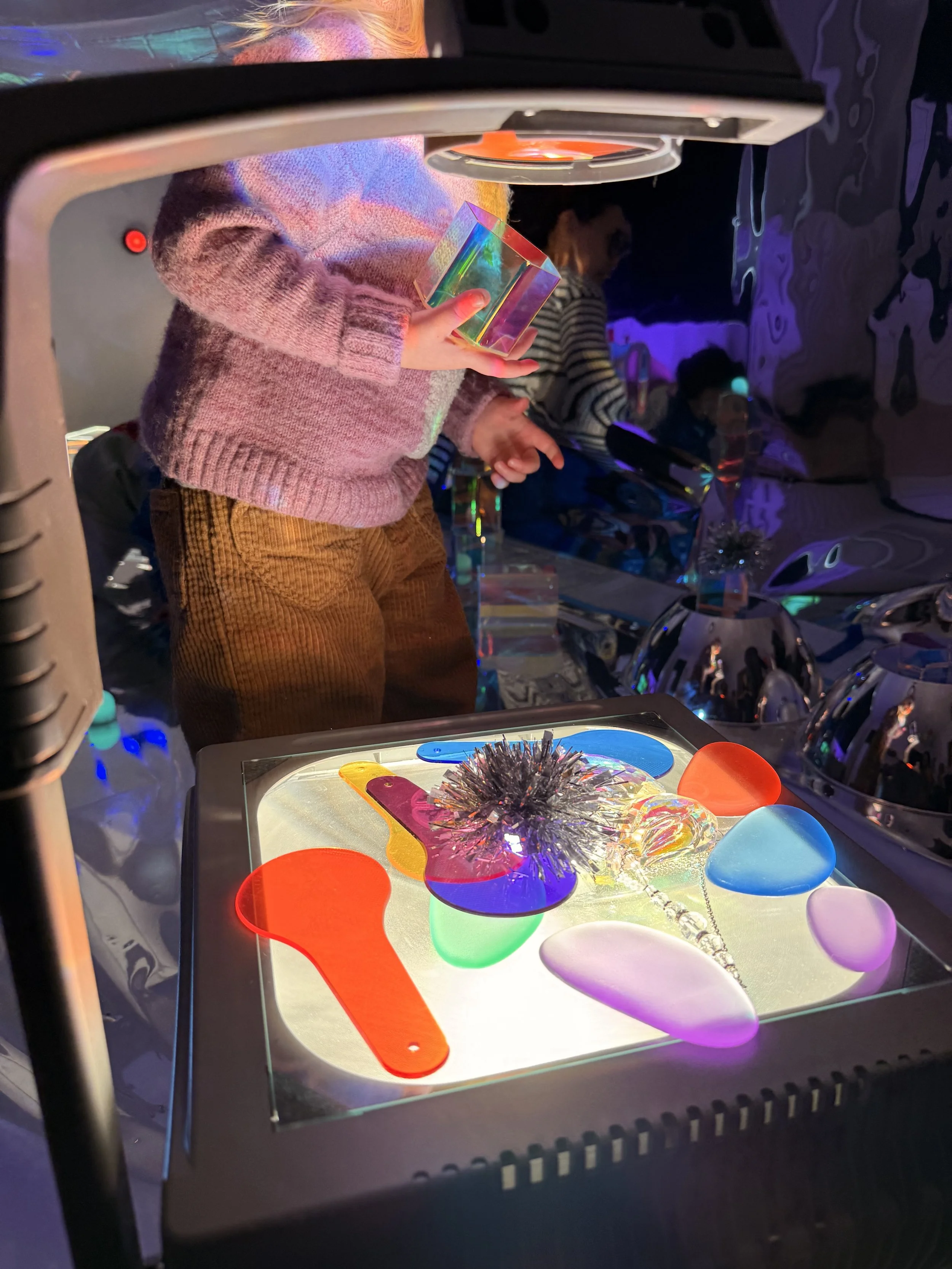
Río joined her, placing a green paddle over the light. The wall turned green. Then red. He tested one after another, delighted by the instant transformations. He also explored the space with flashlights, tracing how the light moved across walls and objects.
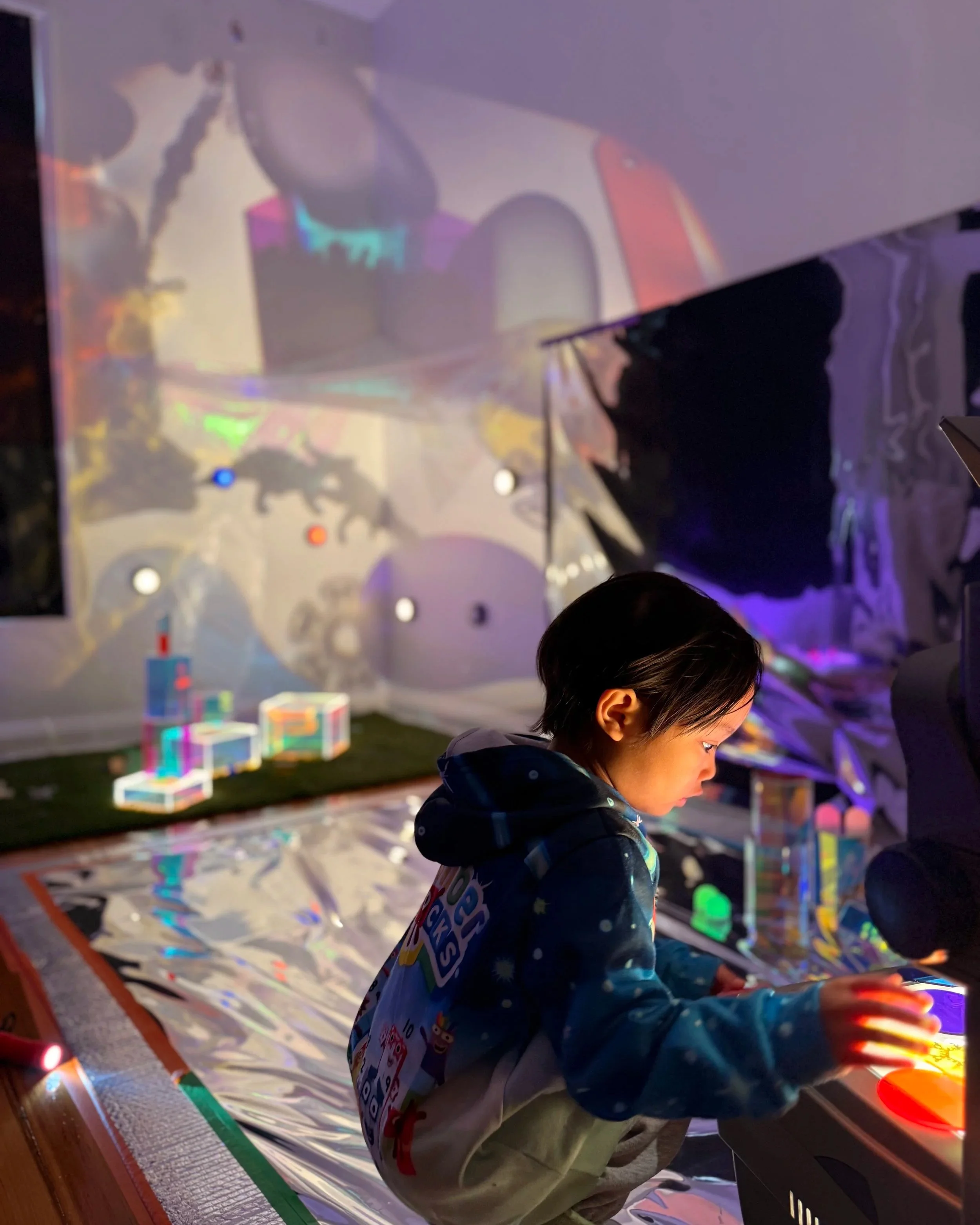
Nearby, Noah manipulated tiny dinosaurs alongside small lights, stacking iridescent cylinders and bringing them to the projector. He looked back at the wall, noticing how such small objects became large, bold images.
Coming Back Together
To close the experience, the children gathered together to read Shadows by Sharon Coan. As they listened, Julie offered language to support their discoveries, connecting their hands-on explorations with ideas about light and shadow.
The room grew quiet again, this time filled with understanding.
The Theories Emerging in the Room
Throughout the experience, the children were forming and testing theories about light and shadow, through action, repetition, and observation.
One theory centered on cause and effect: light responds to action. Gigi’s discoveries, shaking the bowl to make light flicker, covering the projector to create darkness, revealed an understanding that light can be controlled. Each repetition strengthened her idea: when light is blocked, darkness appears.
Another theory explored light as something changeable. Through translucent pegs, colored paddles, stacking gems, and prisms, the children noticed that light could shift color, intensity, and mood. When Aksel looked through a yellow gem and transformed his view of the room, he revealed an understanding that light changes not just objects, but perception itself.
Scale and transformation became visible theories as well. Noah’s exploration with tiny dinosaurs on the projector showed a realization that light can make small things big. Size was no longer fixed; it depended on placement, distance, and light.
Light also became a tool for storytelling and meaning-making. Theo’s snake, eggs, and imagined timeline showed that light could hold narrative, time, and life, not just illumination.
Finally, the children began to understand the relationship between light and darkness. Darkness was not empty or scary, it made shadows visible. It created contrast. It allowed light to speak louder. The room taught them that light and darkness need one another.
These theories were not taught. They emerged, through curiosity, repetition, laughter, and pause.